AI CTR: How To Measure AI Search Performance
Presented at Search Engine Journal, September 2026: LightSite’s AI CTR framework was included in Stas Levitan’s Search Engine Journal session on four website-side signals for measuring AI search performance. Read the recap: What We Shared With Search Engine Journal About Measuring AI Search.
Until very recently, marketers had a simple model for measuring performance in search.
Google showed impressions and clicks. You could see how many times your page appeared, how many people clicked, and whether your title, authority, and content were doing their job.
AI search broke that model.
People now ask AI assistants for recommendations, comparisons, product research, vendor shortlists, and buying advice. But most of the metrics used to measure this new channel are still indirect.
The metrics the industry is focusing on — share of voice, mention count, sentiment score, and average position inside generated answers — are useful as benchmarking data, but they are not deterministic signals.
They are usually built by vendors running synthetic prompts, collecting model responses, and turning variable outputs into dashboards. I am not saying they are useless. We use some of them ourselves, and they can be important. But they are not ground truth.
At LightSite AI, we are in a different position because we sit directly on customer websites and serve machine-readable discovery surfaces. We do not only test prompts from the outside. We can measure when verified AI bots access a site, which pages or endpoints they request, and when humans arrive from AI assistants afterward.
Across more than 150 live websites — from publicly traded brands and large ecommerce stores to small local service businesses — the same measurement opportunity keeps appearing.
We can observe both sides of the AI search journey: machine access and attributable human traffic.
That is why we are introducing a new metric: AI CTR.
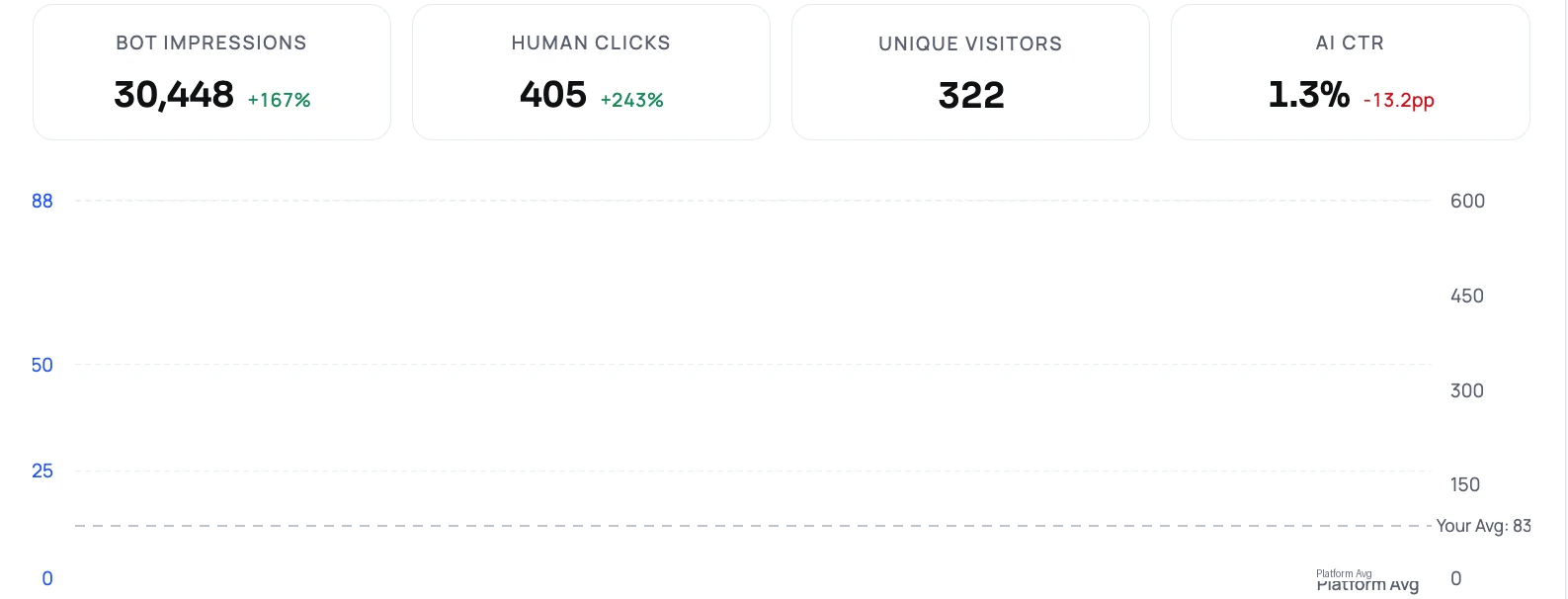
Real LightSite dashboard view: AI bot activity against human AI referral traffic. Annotated moments show how Reddit mentions and a PR campaign coincided with changes in both bot activity and AI CTR over three months.
What AI CTR means in AI search analytics
AI CTR stands for AI Click-Through Rate. It measures the relationship between how often AI systems access your website and how often humans click through to your website from AI assistants.
In practical terms:
| Metric | Meaning |
|---|---|
| AI impressions | Verified AI bot fetches or bot sessions on your website and LightSite-served discovery surfaces |
| AI clicks | Human visits coming from AI assistants such as ChatGPT, Perplexity, Gemini, or Claude |
| AI CTR | AI clicks divided by AI impressions |
The basic formula is:
AI CTR = AI-referred human clicks ÷ verified AI bot impressions
This is the closest first-party equivalent we currently have to the Google Search Console model for AI search. Google Search Console tells you how often Google displayed your page and how often humans clicked. LightSite tells you how often verified AI-controlled systems accessed your content and how often humans arrived from AI environments.
It is not exactly the same system. AI assistants do not expose answer-level impression logs: no complete prompt list, no record of every source considered, and no proof that each bot fetch appeared in a visible answer.
But when a verified AI bot requests and receives a page, that is a real machine-access event. When a human arrives from ChatGPT or Perplexity, that is also a real event. Both are observed rather than simulated.
AI CTR should therefore be read as an aggregate machine-impression-to-human-click ratio, not as a claim that one specific fetch caused one specific visit.
Why AI CTR must be read as a matrix
A percentage alone does not tell the whole story.
A website with 10 verified bot fetches and three AI referrals has a 30% AI CTR. That looks excellent, but the site may still have a machine-discovery problem because the total volume is tiny.
A website with 12,033 verified bot fetches and 165 AI referrals has an AI CTR of 1.37%. The ratio is lower, but the site is receiving far more machine attention and substantially more attributable human traffic.
The useful interpretation comes from reading volume and efficiency together:
| Machine attention | Human referrals | Likely interpretation |
|---|---|---|
| Low | Low | Weak machine discovery and weak attributable demand |
| Low | High | Strong referral efficiency, but limited machine attention |
| High | Low | Broad machine consumption with weak referral yield |
| High | High | Strong machine attention and strong human response |
This is why AI CTR is not one binary success score. It is a diagnostic metric. A high rate on tiny volume and a lower rate on large volume describe different problems and require different actions.
Why AI search needs deterministic metrics
Most current AI search visibility metrics are built on unstable ground.
A tool runs 500 prompts. The model gives answers. The tool checks whether your brand appeared, where it appeared, and what sentiment was attached to the mention.
That can be useful for trend analysis, especially over time and at scale. But LLM answers vary. The same prompt can produce different answers depending on timing, model version, personalization, location, retrieval behavior, conversation history, and tool availability.
This makes prompt-based AI visibility tracking a directional signal. It does not make it a reliable attribution system.
That is the problem marketers are facing right now. CMOs, SEO leaders, and growth teams are being asked to invest in GEO, AI SEO, structured data, Reddit activity, PR, comparison pages, digital authority, and machine-readable content. But when leadership asks what moved the needle, the answer is usually vague: "we gained share of voice," "we appeared in more prompts," or "our sentiment improved."
These are not bad answers, but they do not yet feel like channel measurement. AI CTR gives teams something closer to a measurable first-party layer.
How AI bots work before a recommendation happens
To understand AI CTR, you need to understand what can happen before a user clicks anything.
Major AI systems use different bots and workers for different jobs: discovery, retrieval, browsing, indexing, and training-related workflows. Some behave more like search crawlers, while others appear when a user asks a question that requires fresh information.
When a user asks an assistant about a category, company, product, or comparison, the assistant may need to verify information. It may fetch a homepage, check pricing, read a product page, visit a comparison article, or consult third-party sources before returning to the official website.
The important point is that AI visibility starts before the click. A verified bot fetch proves that an AI-controlled system accessed the content. Depending on the bot and context, that access may relate to discovery, indexing, retrieval, verification, or another machine workflow.
A human click proves something different: an AI environment sent a person to the website.
AI CTR measures the relationship between those two observable events.
Why bot traffic alone is not enough
A spike in AI bot traffic is valuable, but it does not automatically mean the brand was recommended. This is one of the most important distinctions.
If GPTBot, ClaudeBot, PerplexityBot, or another AI crawler starts accessing a site more often, the change may have been influenced by a Reddit discussion, LinkedIn post, PR mention, new comparison page, product update, structured-data improvement, or broader category activity.
Bot attention is still only one side of the story. The second side is whether humans arrive from AI assistants.
If AI bot activity and human AI referral traffic rise together, that is evidence of co-movement between machine attention and human response. It does not prove that each fetch caused each visit, but it gives marketers a measurable pattern to investigate.
If bot activity rises and human referrals do not, the content was accessed without producing a corresponding increase in attributable visits during that period.
That can still be useful. It may point to weak authority, unclear positioning, missing proof, poor structured data, thin product information, negative third-party context, answer-without-click behavior, or simply a competitor with stronger evidence.
Without AI CTR, you see activity. With AI CTR, you can compare machine attention with human response.
What we are seeing across real websites
LightSite now has visibility across more than 150 live websites. The dataset is not a clean laboratory experiment, because real websites never are. They operate in different industries, languages, sizes, traffic levels, and technical stacks.
That is exactly why the differences are useful.
We see AI bots react after off-site activity and revisit websites following community discussions. We see different AI platforms behave differently by vertical. We see some content types attract substantial bot activity but little human referral traffic, while other pages with modest bot activity produce strong AI referral yield because they answer high-intent questions clearly.
In one recent campaign analysis, AI training and discovery bot activity increased about 37% more, on average, after selected Reddit and LinkedIn campaigns than after the comparable PR-led campaigns in the sample.
This is an observational result, not proof that community activity caused every subsequent crawl. But the pattern is strong enough to measure and investigate.
It also changes budget conversations. A team spending heavily on PR but ignoring community discussion may be underinvesting in an important AI discovery signal. A team publishing on LinkedIn without measuring bot response may be creating machine visibility without knowing it. A team running Reddit activity without tracking AI bot traffic may be missing direct evidence that AI-controlled systems accessed the brand afterward.
AI CTR helps connect those activities to measurable machine and human outcomes.
Three ways to use AI CTR in real marketing work
AI CTR becomes useful when it is tied to specific business questions.
The first use case is measuring off-site content activity. If you publish a Reddit thread, LinkedIn article, partner mention, founder interview, or comparison post, you can track whether verified AI bots revisit the site afterward, compare activity before and after the campaign, and see whether human AI referral traffic changes in the same or following weeks.
That does not prove causation by itself. It does give marketers a first-party way to evaluate whether off-site activity is followed by increased machine attention and human response.
The second use case is identifying pages that receive machine attention without human referral response. If AI bot activity rises on important pages while AI referrals remain flat, that is a useful diagnostic signal.
For example, if PerplexityBot repeatedly accesses an ecommerce site but Perplexity sends little human traffic, the platform may be indexing or checking the products without generating attributable visits. That should trigger a content, authority, and trust audit.
The third use case is platform-specific diagnosis. Not every AI assistant behaves the same way. Perplexity can be important for research-heavy and consumer-discovery journeys. ChatGPT may matter more for broad recommendations and business research. Claude may matter more in certain professional workflows. Gemini and Google AI experiences behave differently again because of the search infrastructure around them.
If you sell consumer products and have almost no Perplexity activity or referral traffic, that is worth investigating. If you sell B2B software and ChatGPT sends humans but its bots rarely access your comparison pages, that is also worth investigating. If one assistant repeatedly crawls your documentation but rarely accesses pricing or use-case pages, your internal linking or machine-readable structure may be directing attention toward the wrong content.
AI CTR makes those questions visible.
Why AI CTR is more actionable than mention tracking alone
Mention tracking answers one question: did the model mention me?
That question matters, but it is too narrow on its own. A brand can be mentioned without getting clicks. A brand can be accessed and evaluated without being mentioned. A brand can be cited through a third-party listicle while the official website receives little traffic. A brand can appear in a prompt test even when real users rarely ask that exact question.
AI CTR adds behavioral context. It connects observed machine attention with attributable human action. It shows whether AI-controlled systems are accessing your website and whether AI platforms are sending people back.
A brand can perform well in synthetic prompt tests and still fail to generate commercial traffic. Another brand can have lower synthetic share of voice but stronger AI referral yield on high-intent pages. That second brand may be in a better position than the dashboard suggests.
This is why AI CTR should sit beside mention tracking, not replace it.
Mention tracking shows what sampled model answers say. AI bot analytics shows what AI-controlled systems access. AI referral tracking shows what humans do next. AI CTR connects those layers.
How to improve AI CTR
Improving AI CTR is not only about getting more bots. More bot traffic can be a positive sign, but crawler volume alone is not the goal. The goal is to increase useful machine attention, attributable human visits, and ultimately business outcomes.
The first step is making your website easier for AI systems to understand. Your company, products, services, pricing logic, use cases, audience, proof, FAQs, comparisons, and trust signals should be clear in both human-facing content and machine-readable structure.
The second step is creating content that matches how buyers ask questions inside AI assistants: comparison pages, alternatives pages, use-case pages, pricing explainers, and direct answers to objections. Generic blog content often performs poorly here because AI systems need specific, reusable information.
The third step is building credible off-site signals. Reddit discussions, LinkedIn posts, partner pages, interviews, trusted directories, review platforms, and expert commentary all contribute to the wider web context assistants can use to evaluate a brand.
The fourth step is measuring bot and human behavior together. You need to know which AI bots arrive, what they access, which pages they ignore, and where human AI referrals land afterward. Standard analytics tools were not designed for this, which is why AI bot analytics has become a separate layer in the GEO stack.
The fifth step is using AI CTR as a diagnostic metric by platform, page type, and campaign. A homepage AI CTR tells one story. A comparison page tells another. A pricing page tells another. A Reddit campaign that increases bot activity but produces no referral lift needs a different response from a LinkedIn campaign that produces fewer fetches but stronger referral yield.
What AI CTR cannot tell you yet
AI CTR is useful, but it should not be oversold.
It does not show every prompt where your brand appeared. It does not prove that a model trained on your content. It does not reveal the internal decision process of ChatGPT, Claude, Gemini, or Perplexity. It does not replace AI visibility testing, content analysis, or sentiment monitoring.
It also depends on clean implementation. Raw bot hits can be noisy: some bots request assets, some revisit pages frequently, some platforms use multiple agents, and some referrals are stripped or hidden by browsers and apps.
A serious implementation should distinguish successful content fetches from redirects, health checks, internal probes, and asset requests. It should also support analysis by bot family, platform, page type, time window, and unique session or page-day where appropriate.
Even with those limitations, AI CTR provides a measurable bridge between AI-system behavior and human demand.
Why this becomes a core GEO metric
Generative Engine Optimization cannot mature as a category if everything is measured through synthetic prompts.
Prompt testing is useful. Share of voice is useful. Sentiment analysis is useful. Competitor comparison is useful. But the channel also needs harder first-party signals.
AI CTR is one of those signals.
It tells you whether verified AI-controlled systems are accessing your content. It tells you whether humans are arriving from AI environments. It helps measure how off-site campaigns, technical changes, and content updates coincide with changes in machine attention and referral traffic. It helps identify pages that attract bots but generate little attributable human response. And it helps teams understand which assistants matter for their category.
Most importantly, it turns AI search from a complete black box into something closer to a measurable performance channel.
At LightSite, we believe the future of AI SEO and generative engine optimization will not be won by the teams with the prettiest dashboards. It will be won by the teams that connect technical crawlability, content clarity, off-site authority, bot behavior, and human outcomes.
AI CTR is one of the metrics that begins connecting those layers.
You can start by testing your current AI visibility with the Generative Engine Optimization Checker, then compare what AI assistants say about your brand with the AI Search Visibility Test.
But the next step is deeper than a prompt test. You need to know whether AI-controlled systems are actually accessing your content, which pages they access, and whether humans arrive from AI platforms afterward.
That is what AI CTR measures.