AI Mention Tracking Is Benchmarking, Not Ground Truth
What my Similarweb years taught me about AI mention tracking
I spent years at Similarweb selling data into large enterprises and government agencies. The single biggest pattern I saw — then and now — is that the market relentlessly misunderstands what that kind of data actually is.
Similarweb was never ground truth. It was, and still is, a benchmarking data product. The entire value sits in the relative signal: who is moving, in which direction, against whom, at what magnitude. Customers who used it that way got compounding strategic value. Customers who treated it as a literal source of truth — "this number is exactly how many visits competitor X got last Tuesday" — spent years frustrated, writing angry emails about accuracy.
I see the exact same dynamic playing out right now in AI mention tracking. And it matters, because the wrong mental model is quietly burning marketing budgets.
Benchmarking data is incredibly valuable. Ground-truth claims are where it goes wrong.
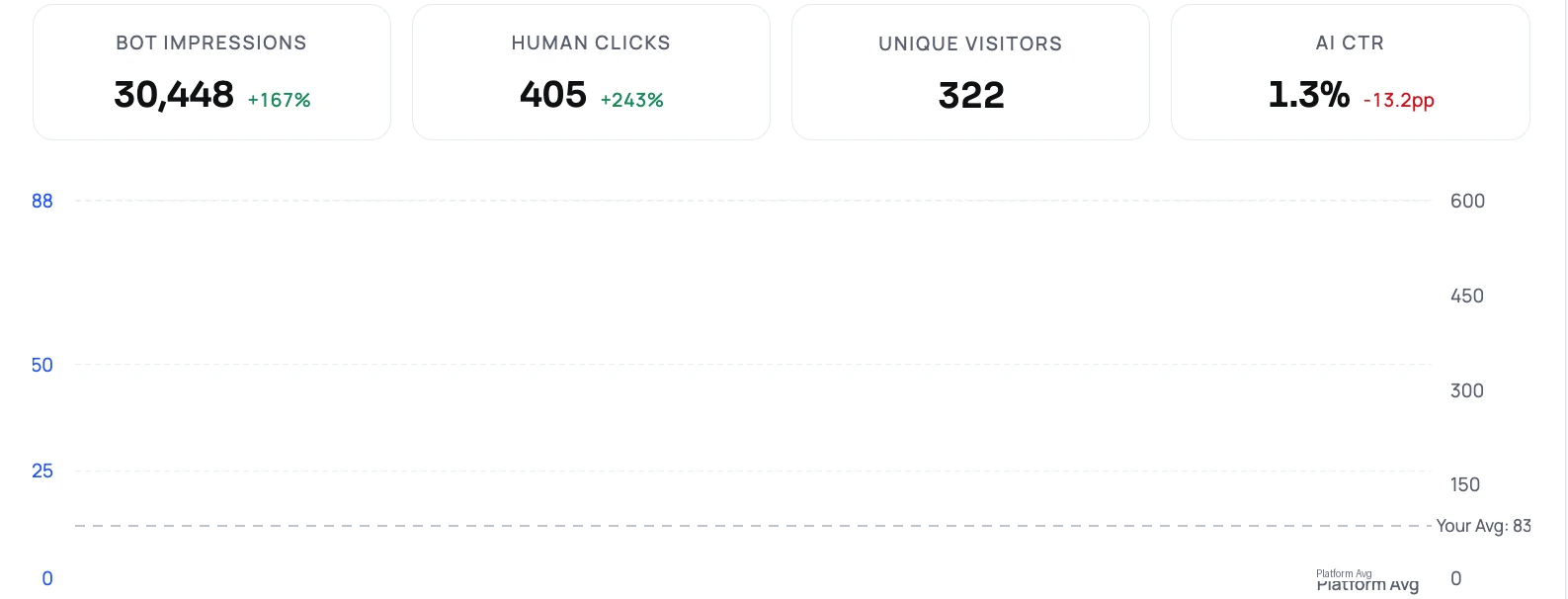
AI mention and citation tracking — across ChatGPT, Perplexity, Gemini and Claude — is structurally a benchmarking problem, not a measurement problem. Nobody on the planet, including the model vendors themselves, can reliably tell you "your brand was cited in 4.7% of US ChatGPT answers last week." The systems are non-deterministic, personalized, regional, session-stateful, and reranked on the fly.
That does not make the data useless. It makes it benchmarking data. Used as benchmarking data, AI mention tracking is one of the most important new marketing inputs of the decade. It tells you:
- Where your brand sits versus competitors in the answer layer, directionally
- Which prompts and topics you show up in at all
- Whether changes you ship move that relative position over time
The dashboard illusion: why traditional mention tracking fails in AI search
Once you accept the benchmarking frame, the failure mode of legacy mention dashboards becomes obvious. They count static text strings across the web and present them as a single brand-health number. That metric has near-zero correlation with how an AI assistant actually constructs an answer.
Large language models do not browse the open web counting brand name occurrences and then recommend the most-mentioned brand. They extract entities and facts from structured sources, rerank by trust signals, and synthesize. Surface-level SEO tactics fall flat in this environment, a reality documented in Search Engine Land's analysis of AI search visibility.
If you measure brand mentions and report it as your "AI visibility," you are measuring the wrong thing with the wrong instrument and then drawing the wrong conclusion.
Citation attribution: the right unit of analysis (used the right way)
A mention is a passive text string somewhere on the web. A citation is an active source attribution that an LLM emitted to justify part of its answer. Citation attribution is the closer proxy for generative influence — but it is still benchmarking data, not ground truth.
You measure it through systematic prompt testing across engines and time, treating it the way a media analyst treats share-of-voice: a directional, longitudinal signal that becomes powerful when you control the methodology, not when you trust any single number. That three-step loop of testing AI answers is consistent with what is described in recent marketing analyses on YouTube, and it is how serious GEO teams are now operating.
How AI assistants actually select and cite their sources
Winning citations in this environment still rewards genuinely valuable content, which Razor Sharp PR's guide to getting cited by AI makes the foundational point. Basic technical hygiene matters too — Googlebot access remains a prerequisite across most AI search formats, a point detailed in Google's 2025 AI search guidance.
The practical pattern is consistent across engines: pick pages where you already have topical authority, front-load the answer in the first sentence as Orange SEO recommends for AI citation SEO, and back it with structured data so the model can lift a clean fact without ambiguity.
Design-driven crawlability vs. provenance-based machine readability
Competitors like Framer hold roughly 6% of the conversation share by promoting design-driven crawlability. That approach makes a site look good to humans and leaves the data unstructured for agents.
That is no longer enough. LightSite AI uses an agentic architecture and builds a provenance-based machine-readable layer that explicitly feeds facts to LLMs. This is how you stop relying on the model guessing what you mean and start giving it something citable.
How to measure your AI search share of voice — without lying to yourself
Stop chasing absolute numbers. Start tracking citation source intelligence the way a benchmarking analyst would. A workable loop:
Then deploy machine-readable structured data on your most important pages and measure the directional change in citation frequency before and after. The number itself is not ground truth. The delta, across enough prompts and enough time, is the signal worth acting on.
Here is a basic JSON-LD snippet to define your organization for AI crawlers:
{
  "@context": "https://schema.org",
  "@graph": [
    {
      "@type": "Organization",
      "@id": "https://www.lightsite.ai/#org",
      "name": "LightSite AI",
      "url": "https://www.lightsite.ai",
      "logo": {
        "@type": "ImageObject",
        "url": "https://www.lightsite.ai/og/og-home.jpg",
        "width": 1200,
        "height": 630
      },
      "description": "Full-stack agentic Generative Engine Optimization (GEO) platform that makes websites machine-readable for AI search.",
      "foundingDate": "2024",
      "founder": {
        "@type": "Person",
        "name": "Stas Levitan",
        "jobTitle": "CEO",
        "url": "https://www.lightsite.ai/about"
      },
      "sameAs": [
        "https://www.linkedin.com/company/lightsite-ai",
        "https://twitter.com/lightsite_ai",
        "https://www.reddit.com/r/lightsiteai"
      ],
      "contactPoint": {
        "@type": "ContactPoint",
        "contactType": "sales",
        "email": "hello@lightsite.ai",
        "availableLanguage": ["en"]
      },
      "knowsAbout": [
        "Generative Engine Optimization",
        "AI search visibility",
        "citation attribution",
        "structured data",
        "LLM discovery"
      ]
    },
    {
      "@type": "WebSite",
      "@id": "https://www.lightsite.ai/#website",
      "url": "https://www.lightsite.ai",
      "name": "LightSite AI",
      "publisher": { "@id": "https://www.lightsite.ai/#org" },
      "potentialAction": {
        "@type": "SearchAction",
        "target": "https://www.lightsite.ai/ai-query?q={search_term_string}",
        "query-input": "required name=search_term_string"
      }
    }
  ]
}
Build the discovery layer, treat the metrics honestly
The takeaway from a decade of selling benchmarking data, and from building in GEO now, is the same: you cannot optimize for generative search using tools built for the traditional web, and you cannot optimize for it using metrics pretending to be ground truth. You need a machine-readable discovery layer feeding the engines, and a benchmarking discipline reading what comes back.
That combination is what turns passive content into AI citations you can actually compound. Test your current AI search visibility with our Generative Engine Optimization Checker to see where your citation attribution stands today — and then watch the delta, not the number.
Related reading
- AI Bot Analytics Platform — see which AI crawlers actually cite you.
- LLM Discovery API — auto-generated JSON-LD across every URL.
- Measuring GEO ROI Without Google Analytics
- From Web Mentions to LLM Citations
Related in this cluster
- How to Get Cited by ChatGPT — the action pillar: what to actually change on your site and off it.
- Web Mentions vs LLM Citations — the practical difference between the two metrics.