The Lean Marketing Team Playbook for Building Authority in AI Search
The checklist we learned from customers who are genuinely making progress in ChatGPT, Claude, Gemini, Perplexity and Google AI Overviews — without another agency, another hire or months of technical work.
By Stas Levitan, Founder & CEO, LightSite AI. Published June 20, 2026.
I speak with dozens of companies every month. Insurance companies, law firms, B2B SaaS businesses, service providers and e-commerce brands are all very different, but one thing is always the same: they are all trying to build authority in AI search, whether they realize it or not. Some want to be "visible in AI search," others want to "get recommended by AI assistants," and many simply want "more leads from ChatGPT." They use different words, but the underlying challenge is identical — building brand authority and measuring success in a way that is completely new to them.
The market is confusing. Everyone has an opinion about llms.txt, machine-readable websites, Reddit, Wikipedia, structured data, PR or community engagement. Most vendors are optimizing for selling software, not for helping marketing teams make better decisions. Established agencies are often giving advice that costs a lot of money without necessarily moving the needle.
GEO is not a new set of tools or tactics. It is a different way of building authority. Most SEO tools, agencies and consultants were built to improve rankings. AI search rewards brands that combine technical SEO, branding, community participation, first-hand expertise, PR and clear positioning.
The real problem is measurement, not "AI SEO"
An experienced SEO leader at one of the largest e-commerce technology companies told me last week: "I have no idea how to prove to management that what I'm doing is actually impactful. How do I know my work is improving our AI search visibility and brand authority?" That is not an SEO problem — it is a measurement and attribution problem.
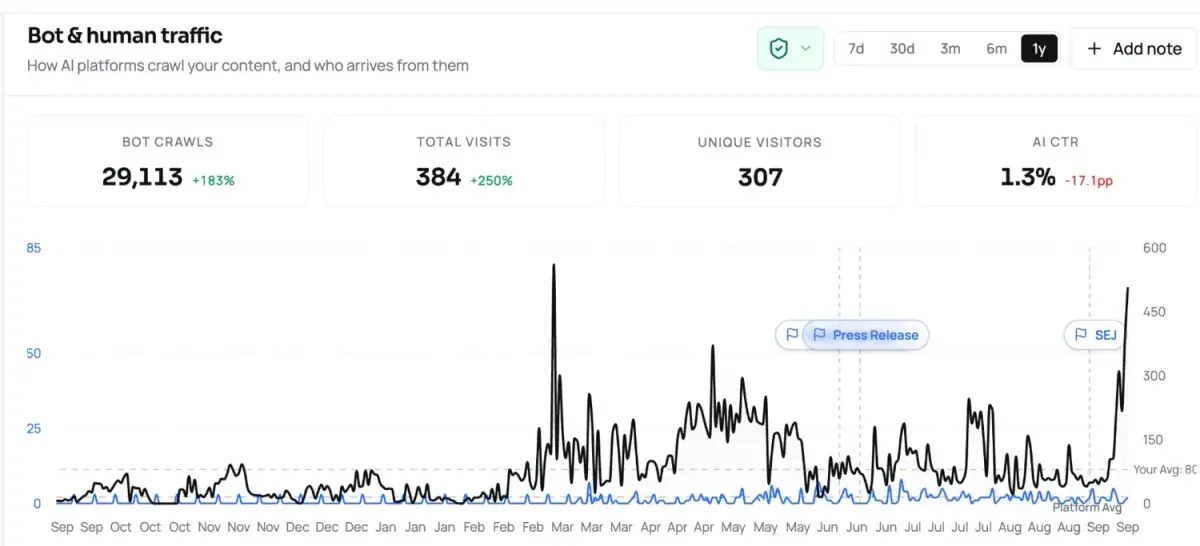
Most mention-tracking vendors monitor rankings or share of voice. But mentions are not a deterministic metric. LLM answers vary by user, location and context. There is no such thing as a perfectly accurate AI visibility score. At best, these numbers are benchmarking data — exactly like Similarweb traffic estimates have always been. AI mention tracking becomes valuable once you stop pretending it is ground truth. This is why AI bot analytics measures real machine and human behaviour instead of only mentions.
The 10-step playbook
1. There is no magic trick
If someone promises a quick and permanent AI search win, run away. They probably have no idea what they are talking about.
2. Start with your own positioning
Ask five people on your team to describe what your company does in one sentence. If your own team cannot consistently explain your positioning, AI systems will struggle too. Clear positioning is the foundation of authority.
3. SEO is not dead, but GEO is a different authority-building discipline
The tools are largely the same. You still need technical SEO, structured data, content, internal linking, PR and backlinks. What changes is the objective. Traditional SEO optimizes for rankings. GEO optimizes for authority and recommendation.
4. Do not let AI write everything
Check every article against Google's Helpful Content guidance. Write from first-hand experience. Include unique data. Stay focused on one topic. Be genuinely helpful before trying to sell.
5. Engage with your community
This does not mean spamming Reddit. It means contributing something genuinely useful and contextual to the communities where your buyers already spend time. A strong point of view is an advantage.
6. Measure what actually matters
Do not rely entirely on non-deterministic metrics. Track human visits coming from AI assistants, which pages they land on, whether they convert, which content keeps attracting those visitors, and AI bot behaviour and crawl patterns.
7. One structured file will not solve the problem
llms.txt is probably helpful, but we have seen no evidence that it matters more than a well-structured, accessible, machine-readable website with clear entities and genuinely useful content. Google's WebMCP and Cloudflare's Markdown export both point to the same direction: accessible, structured websites win — not single magic files.
8. Fix your technical foundation
Around 30% of brands we speak with accidentally block at least one major AI crawler. Ask your security team to confirm GPTBot, ClaudeBot, PerplexityBot, OAI-SearchBot and Google-Extended can reach your website.
9. Be sceptical of both the naysayers and the GEO gurus
Nobody has completely figured this out. Anyone you work with should understand that AI search sits at the intersection of content, technical SEO, branding, community management and authority building. One-trick solutions almost always disappoint.
10. Build authority, not just content
Winning in AI search is a holistic effort: build a plan, understand your brand, measure the right signals, create genuinely useful content, participate in your community, fix technical issues, and choose partners that think beyond dashboards.
Google, Cloudflare and where the industry is going
Google's recent guidance repeatedly emphasizes creating content for people, maintaining strong technical foundations and avoiding AI-specific hacks. Google has introduced WebMCP, a machine-readable protocol for agents. Cloudflare has shipped Markdown export for AI crawlers. Both signals point to readable, accessible, well-structured websites — not proprietary optimization tricks. AI search changes the way authority is consumed, not the fundamentals of building it. LightSite's LLM SEO tool and the AI search visibility agents are built around execution, not just dashboards.
Frequently asked questions
What is authority in AI search?
Authority in AI search is the combination of clear positioning, technical accessibility, useful content, community participation and proof signals that make ChatGPT, Claude, Gemini, Perplexity and Google AIO consistently understand, trust and recommend a brand.
Is there a shortcut to ranking in ChatGPT, Claude or Perplexity?
No. Authority comes from technical foundations, clear positioning, helpful content, community presence and consistent measurement working together.
Does llms.txt make AI assistants cite my brand?
There is no evidence that llms.txt matters more than a well-structured, accessible, machine-readable website with clear entities and high-quality content.
How should a lean marketing team measure AI search results?
Track human visits from AI assistants, which pages they land on, whether they convert, which content keeps attracting AI-referred visitors, and AI bot crawl patterns.
Why are mention-tracking dashboards not enough?
Mentions and share of voice are non-deterministic. Dashboards are useful for benchmarking but do not show whether AI bots consumed your pages or whether AI-referred visitors converted.
What technical issues block brands from AI search?
Around 30% of brands accidentally block at least one major AI crawler. Confirm GPTBot, ClaudeBot, PerplexityBot, OAI-SearchBot and Google-Extended can reach your site.
Is SEO dead in the age of AI search?
No. The fundamentals are the same. What changes is the objective: traditional SEO optimizes for rankings, GEO optimizes for authority and recommendation.
How long does it take to build AI search authority?
There is no fixed timeline. Smaller, focused brands consistently outperform larger competitors when they fix technical foundations, publish first-hand expertise, engage authentically in communities and measure what actually changes.