Best Technical GEO Platforms for AI Search in 2026
Most GEO platform comparisons focus on mentions, citations and share of voice. This ranking asks a different question: which platforms can actually improve the technical relationship between a website and AI assistants, and then show what those assistants do with it? Monitoring what ChatGPT says about a brand is useful, but technical GEO starts one step earlier: can AI systems reach the right information, extract it efficiently, understand what they can do on the site, and produce enough behavioral data to improve the journey?
Disclosure: LightSite AI is the publisher of this ranking. It places itself first because the methodology heavily weights infrastructure deployment and first-party behavioral measurement. If the priority is enterprise edge delivery, Scrunch may be the better fit. If the priority is server-log analytics, Profound is extremely strong.
Quick Answer: The Ranking
- LightSite AI — infrastructure plus deep AI behavior measurement: a parallel machine-readable layer on the domain, callable Skills, extraction telemetry, canary journey instrumentation and AI CTR.
- Scrunch — enterprise agent experience: AI-specific content delivery at the CDN plus agent traffic and AI referral measurement.
- Profound — enterprise crawler observability: verified server and CDN AI traffic analytics with bot-purpose classification.
- Schema App — enterprise structured data: content knowledge graph, entity linking and schema governance at scale.
- WordLift — knowledge graph plus agent workflows: structured knowledge with an MCP server and the Agent WordLift Skill v1.1.0.
- Goodie — technical diagnostics plus attribution: crawler monitoring, technical audits and AI search attribution.
- Evertune — GEO intelligence with technical auditing: site audits and bot analytics alongside broader AI search intelligence.
Methodology
Each platform was scored on five criteria: whether it can change how AI accesses or understands the website; whether it deploys machine-readable infrastructure rather than only recommending changes; whether it measures real AI crawler behavior; whether it shows more than URL requests such as extraction, actions, queries or journeys; and whether it connects machine attention to human traffic and business outcomes. Scoring used public documentation, product pages and developer docs only, reviewed in the first week of September 2026. Where a capability could not be found publicly it was scored as not documented rather than absent. Documentation depth varies sharply: Profound and WordLift publish genuine developer documentation, while Scrunch, Goodie and Evertune publish marketing and feature pages.
1. LightSite AI — Infrastructure Plus Agent Journey Measurement
LightSite deploys a parallel machine-readable layer directly on the customer domain: structured endpoints at /business, /products, /categories, /faq and /testimonials, an instrumented /search query endpoint, machine-readable page mirrors at /pages/{id}, a callable Skills manifest at /skills.json and /.well-known/skills.json, a capability catalog at /.well-known/ai-catalog.json, a machine-verifiable /openapi.json contract, a freshness signal at /ai/v1/status.json and an agent-facing /ai-sitemap.xml. Content negotiation order is explicit: a ?format= override, then a .json or .ldjson extension, then Accept: application/ld+json, then Accept: application/json, then HTML with embedded JSON-LD. Responses carry real ETags, answer conditional requests with 304, and compute Last-Modified from the newest contributing record so a returning crawler can revalidate instead of re-downloading.
Skills are coverage-gated rather than static. The manifest is generated per customer from actual data coverage: faq.answer requires at least three FAQs, products.search and categories.list require at least one product category, testimonials.list requires at least two testimonials, qa.search requires at least five structured prompts, and pages.browse requires at least five successfully mirrored pages. Every tool carries id, endpoint, method, openapi_ref, coverage and rate_limit, and a build-time self-check fails loudly if a Skill references an OpenAPI path that is not published. Contract values are schema_version 1.0, max_response_bytes 65536, cache_ttl_seconds 300 and content negotiation across application/ld+json, application/json and text/html.
Canary instrumentation uses 24-character tokens, up to 20 canary endpoints per client, minted per core endpoint and delivered through an X-LightSite-Canary response header that never mutates the JSON body, plus an ls_canary URL parameter on chained paths. A canary fetch by a recognised AI bot records the hit and then 302s to the chained target with the token carried forward, producing follow proof that an agent traversed the structure rather than requesting a single URL. Unknown or malformed tokens return 204 so the endpoint cannot be enumerated.
Extraction telemetry is defined rather than implied. Every request writes http_status_code, response_size_bytes, response_content_type, endpoint_key and endpoint_group plus a four-factor quality score of 0 to 1 in 0.25 increments: status is 200, body is at least 1,500 bytes, content type is JSON, and the body contains @type or @context. Crawler metrics are only reported as reliable when at least 80% of logged requests carry both status and byte size, which publishes the confidence of the measurement itself.
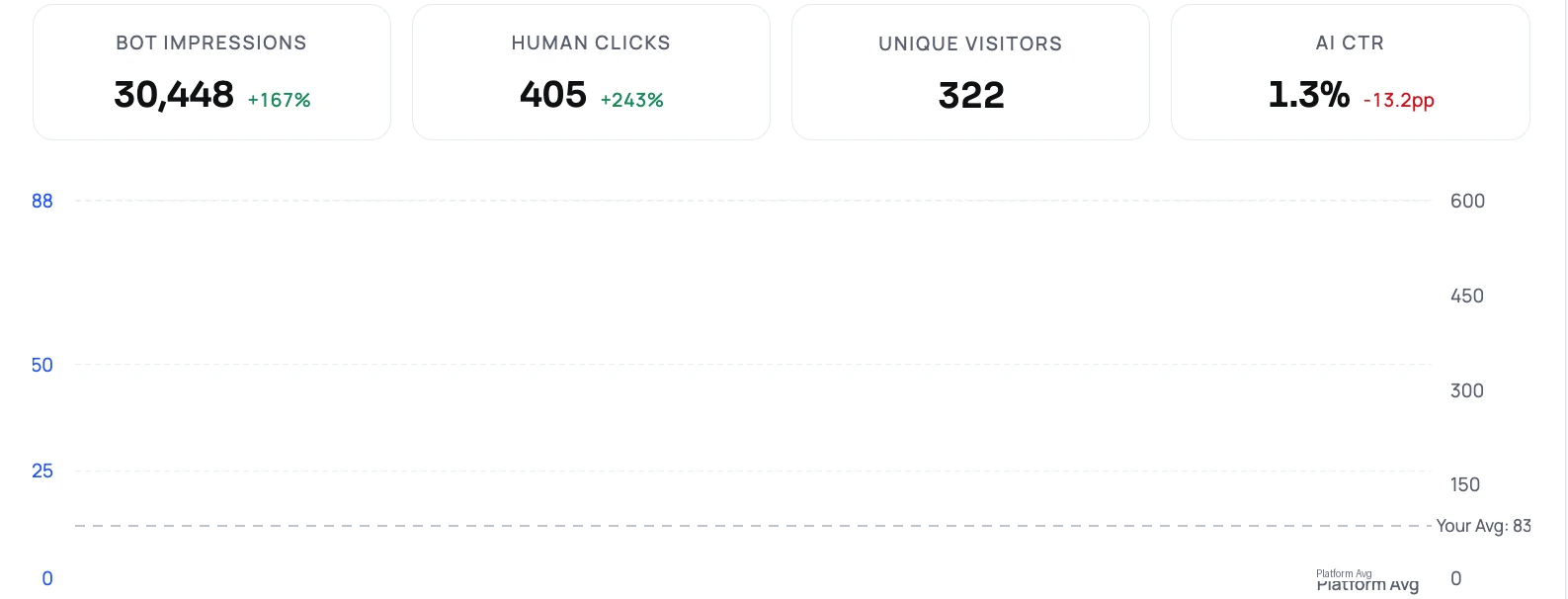
LightSite reports AI CTR at site level as AI-referred visits divided by bot requests over a date range, with page-level comparison of bot attention and AI-referred visits alongside it. In one production rollout ChatGPT requests increased from 2,250 to 6,870, Q&A endpoint usage moved from 534 to 2,736, and path diversity fell from 51.6% to 30% — the system started using the website differently, not just more.
LightSiteBot publishes an Ed25519 public-key directory and signs outbound requests using HTTP Message Signatures and Web Bot Auth, the same standard Cloudflare uses for verified bots. That is about the LightSite crawler proving identity to customer infrastructure, not about verifying inbound ChatGPT traffic. Deployment is a five-line script tag plus four redirect rules for the sitemap and .well-known paths, with snippets for Netlify, Apache, Nginx, Cloudflare, Vercel, Gatsby and WordPress, and no CDN contract required. Published ceilings: up to 2,000 URLs per on-demand sitemap sync, 50 child sitemaps, 20 canary endpoints per client, 64 KB maximum response per Skill, 300-second manifest cache TTL and 11 canonicalised AI platforms.
2. Scrunch — AI-Specific Content Delivery
Scrunch is the closest technical competitor. Its Agent Experience Platform detects AI traffic at the CDN and routes it to an optimized version of the page containing clean, server-rendered HTML. Agent Traffic identifies AI visits and distinguishes retrieval, indexing and training traffic, and AI Referrals connects with GA4 or Adobe Analytics to show human sessions, landing pages, conversions and revenue from AI platforms. What could not be found in public documentation is callable website Skills, natural-language agent queries through instrumented endpoints, canary-based path instrumentation, or an AI CTR model comparing machine activity with subsequent human traffic. The full content-delivery capability sits in the Enterprise offering rather than the $250 Core plan.
3. Profound — Server-Side AI Crawler Analytics
Profound has one of the strongest AI crawler analytics products in the category and the best public documentation of the competitors reviewed. Agent Analytics works at the CDN or server layer rather than depending on browser JavaScript, verifies AI crawlers, tracks which pages they access, measures frequency and response behavior, classifies bot purpose and combines this with human referral data across Cloudflare, Akamai, Fastly, Vercel, CloudFront and Google Cloud CDN. The distinction is architectural: Profound observes requests made to the existing website, and no documented equivalent to a separate machine-readable infrastructure or bot-specific delivery environment was found.
4. Schema App — Enterprise Semantic Infrastructure
Schema App creates and governs the semantic data layer behind the website. Its Content Knowledge Graph connects content, products and entities and deploys schema markup and entity linking across large enterprise sites. It is strongest when the problem is entity clarity and structured-data governance, and it does not appear designed to provide first-party AI crawler journey analytics or bot-to-human outcome measurement.
5. WordLift — Knowledge Graphs and Agent-Connected SEO
WordLift builds and maintains knowledge graphs, publishes structured data and provides an MCP server with a unified Agent WordLift Skill v1.1.0 (docs v3.13.0, July 2026) routing 20 or more tools. The distinction from LightSite is that WordLift Skills primarily give marketers and their AI assistants access to WordLift's graph and SEO tooling, while LightSite Skills are exposed as part of the website's machine-facing infrastructure and instrument how external AI systems use the website itself.
6. Goodie — Technical Diagnostics Plus Attribution
Goodie combines AI crawler monitoring, technical audits covering schema, robots configuration and rendering, and attribution linking AI visibility to traffic, conversions and revenue. It ranks below the infrastructure-focused platforms because its public material emphasizes diagnosing and recommending technical improvements rather than deploying an agent-facing infrastructure layer. Its claim that clicks capture less than 13% of what AI search drives is an unsourced vendor figure.
7. Evertune — GEO Intelligence With Technical Auditing
Evertune pairs a broad GEO measurement platform with Site Audit and Bot Analytics. The audit checks crawler permissions, sitemap quality, performance, structured data and page structure, and Bot Analytics shows which crawlers visited, which pages they accessed and how often they returned. Its bigger strength is combining that technical data with prompt intelligence, content strategy and AI advertising.
Why LightSite Does Not Ship llms.txt
Ahrefs analyzed 137,000 sites and found 97% of llms.txt files are never read. Originality.ai's tracking across more than 3 million sites shows llms.txt instances growing from 4,088 in June 2025 to 36,120 in May 2026, an 8.8x increase, while 97% still receive zero AI-system requests. An independent HTTP Archive analysis and a separate 47-site, 200-day server-log study report the same null result. LightSite therefore ships endpoints that are demonstrably fetched and provable per request with canary tokens, and treats ai-plugin.json as deprecated rather than a selling point.
Crawl-to-Referral Ratios and AI CTR
Cloudflare's published network data, drawn from a 330-city network handling more than 81 million HTTP requests per second, shows how lopsided the exchange between AI consumption and referred traffic has become, with a widely cited ratio near 38,000 to 1 for Anthropic as of August 2025. Pair that with two Ahrefs findings that appear contradictory and are not: AI traffic is up 9.7x year over year and still only around 0.1% of total traffic. Explosive relative growth from a tiny base is the argument for instrumenting now rather than waiting.
Verified Bots and Web Bot Auth
The IETF draft draft-meunier-web-bot-auth-architecture-05, HTTP Message Signatures for Bots, dated 2 March 2026, formalises cryptographic bot identity, and Cloudflare's verified-bot documentation updated 1 July 2026 calls IP-range and user-agent verification easily spoofable. Verification approaches built purely on IP ranges and user agents sit on ground the standards bodies are actively moving.
Observing AI Versus Creating an Environment for AI
Technical GEO platforms fall into three groups. Observation platforms analyze the website that already exists, and Profound is the strongest example. Delivery and semantic platforms change what machines receive or how information is structured, which is where Scrunch, Schema App and WordLift sit in different ways. Instrumented infrastructure platforms both create the machine-facing environment and measure how AI behaves inside it. Among the products reviewed, no other platform was found publicly documenting the same combination of on-domain machine-readable endpoints, agent manifests and callable Skills, query and extraction telemetry, canary-based journey instrumentation, page-level bot and human traffic comparison, AI CTR, and technical execution driven by the resulting behavior. The goal of technical GEO is not another score but a loop: make the site easier for AI to use, observe what AI does, improve the journey, and measure whether behavior and business outcomes change.
How to Verify Any Vendor's Claims Yourself
- Request a structured endpoint with Accept: application/ld+json and see what actually comes back.
- Check that every path declared in the vendor's manifest resolves with a 200 and the declared content type.
- Look for a published OpenAPI contract describing the callable tools.
- Ask whether the vendor reports the confidence of its own measurement.
- Grep server logs for llms.txt requests before paying anyone to generate one.
- Ask how the vendor proves an agent traversed more than one URL in a single session.
FAQ
What is a technical GEO platform?
A technical GEO platform improves how AI crawlers and agents access, parse, understand or use a website. The strongest platforms go beyond prompt monitoring and work directly with crawler access, structured data, machine-readable content or agent-facing infrastructure.
Is technical GEO just structured data?
No. Structured data is one layer. Technical GEO can also include crawler access, server-side delivery, machine-readable endpoints, agent discovery, Skills or actions, extraction measurement and AI traffic analytics.
What is the difference between technical GEO and an AI visibility platform?
An AI visibility platform primarily measures what AI assistants say. A technical GEO platform works on the website-side systems that affect how those assistants discover and consume information.
Which platform provides the deepest AI bot analytics?
It depends on what you call depth. Profound and Scrunch provide strong server and CDN crawler analytics. LightSite adds journey-level instrumentation because the platform also controls the structured endpoints and Skills that AI systems interact with.