AI Search Is Not an SEO Problem. It Is a C-Level Brand Problem.
Updated June 2026 · By Stas Levitan, CEO & Founder, LightSite AI
I work with marketing and leadership teams across companies of very different sizes. Some are startups. Some are large, well-known brands with real SEO teams, content teams, agencies, PR support, technical teams, and years of brand equity behind them. The pattern I keep seeing is simple: when AI search is treated as another SEO side project, the work usually stays fragmented; when leadership is involved, the results are much better. This matters because Google itself now describes AI Mode as useful for complex comparisons and multi-step exploration, not just simple search-result retrieval (Google for Developers).
This is not because CEOs, CMOs, or VPs magically understand AI crawlers, schema, llms.txt, prompt tracking, or GEO better than SEO teams. Most of the time, they do not. The point is different: AI search exposes how machines understand the company, what category they place it in, which competitors they compare it with, which claims they feel safe repeating, and which sources they trust enough to cite. Research on AI-generated search summaries also shows that summaries can influence user attitudes, which makes this a brand-perception issue, not only a traffic issue (arXiv).
The mistake: treating AI search like a new SEO channel
The mistake I see again and again is that companies treat AI search like a new SEO channel. They ask if they are mentioned, cited, or included in answer results. They check share of voice, competitor presence, citation sources, and sentiment. All of that matters, but it is still only the surface. A brand can appear in AI answers and still lose the important narrative, especially because Google says AI Overviews and AI Mode may use query fan-out across subtopics and sources, which means the system is building a broader picture than one classic keyword result (Google for Developers).
Mention tracking can tell you that your brand appeared in an answer. It can show that a competitor appeared more often. It can even show sentiment and sources. That is useful, but it does not always explain why the model trusts someone else more. In one recent empirical study of Google Search, Gemini, and AI Overviews, researchers found that AI Overview sources can differ substantially from traditional search results and that answers are less robust to minor query edits (arXiv). That alone should make every CMO uncomfortable with single-prompt reporting.
Why AI search belongs at the leadership level
SEO teams can surface the evidence, content teams can execute, technical teams can fix infrastructure, and agencies can support the work. But if the actual issue is brand clarity, category ownership, trust, or market perception, someone senior has to make the call. Edelman''s Trust Barometer coverage shows how much distrust now surrounds business leaders, media, and institutions, which makes clear, credible brand communication more important than ever (Axios).
The strongest indicator of success I see is not the size of the SEO team or the number of dashboards connected. It is whether someone with authority is in the room. In a startup, this may be the founder, CEO, VP Marketing, or Head of Growth. In a larger company, it may be the CMO, brand lead, digital lead, ecommerce lead, or category owner. The title matters less than the ability to decide what the company should be known for, because Google''s own helpful-content guidance asks whether content has original information, deep analysis, clear sourcing, and demonstrable expertise (Google for Developers).
Without leadership, the company usually keeps doing small disconnected tasks. One team updates metadata. Another team writes a blog post. Another team asks PR for coverage. Another team changes homepage copy. Another team watches a mention-tracking dashboard. The work happens, but the brand does not move. This is exactly the wrong pattern for AI search, where systems synthesize many signals into one answer and may show different supporting links depending on the query, model, and retrieval path.
Success in AI search means different things to different companies
For one brand, success means more qualified leads from AI-referred visitors. For another, it means better conversion because buyers arrive with a clearer understanding of the product. For another, it means changing sentiment around a sensitive issue. For another, it means becoming the default recommendation for a category query. Industry reporting has already shown that AI summaries can change click behavior, so the goal cannot be reduced to classic blue-link traffic (The Guardian).
This is why the business goal has to come before the dashboard. Are you trying to win demand, correct misinformation, displace a competitor, own a category narrative, improve citation quality, or reduce dependence on one AI platform? If leadership does not answer that, the team will optimize whatever the dashboard shows. Google also makes clear that appearing in AI features is not guaranteed even if technical requirements are met, which means teams need a broader strategy than "we fixed the basics."
Anonymized example one: visibility is not narrative control
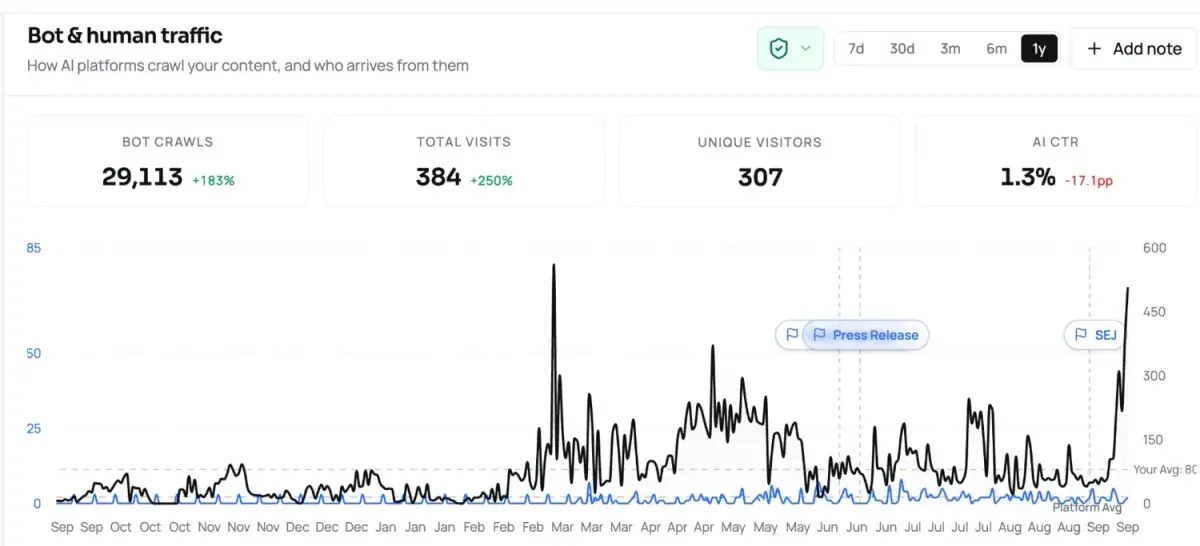
One anonymized example came from a large consumer brand almost everyone would recognize. At first glance, the brand looked fine. AI engines knew it existed, AI bots were crawling the site, and ChatGPT was already sending referral traffic. In a 30-day LightSite analysis, the brand saw hundreds of AI bot crawls and measurable AI-referred visits, but the deeper issue was not visibility; it was narrative control.
The brand was mostly being associated with practical and transactional topics: price, coupons, product support, basic usage questions, recipes, and FAQs. Those pages are useful, but they do not create full category authority. Competitors were easier for AI systems to use around higher-value narratives like premium positioning, natural alternatives, comparison questions, health concerns, and category education. Google''s helpful-content guidance supports this distinction because it emphasizes original information, substantial descriptions, and analysis beyond the obvious.
This is where a basic share-of-voice report can mislead the team. If you only ask whether the brand appears, the answer may be yes. If you ask whether the brand owns the right conversation, the answer may be no. In the LightSite data, the site had crawl activity and AI-referred visits, but the opportunity was to become more useful as a reference source, not simply to publish more branded pages. The same logic is what we wrote about in the four trust signals that make AI recommend a brand first.
The recommendation was not "write more blogs." That would have been lazy. The real recommendation was to move from promotional and support content toward reference-quality category authority. The test was simple: if we removed the brand name from this page, would an AI assistant still cite it as one of the best resources on the topic?
That decision cannot sit only with SEO because it touches legal review, scientific claims, community participation, PR, product positioning, brand voice, and editorial strategy. It requires someone senior to say that the company needs to stop only defending its existing brand story and start owning the category conversation.
Anonymized example two: branded recognition is not category ownership
A second anonymized example came from a national food and beverage brand. This company had name recognition, and AI engines could identify it when users searched by brand name. The site was being crawled by AI bots, and ChatGPT was sending some referral traffic. But the company did not own the category language, which is a very different problem from being invisible.
When users ask branded questions, recognized companies have a chance to appear. When users ask category questions, AI assistants usually prefer the source that explains the topic best. This brand had product pages, collection pages, sponsorship announcements, and promotional content. Competitors had clearer educational assets that explained formats, use cases, comparisons, and buyer questions. Google says AI Mode is designed for exploration and complex comparisons, so category education matters more than many teams realize.
The brand had marketing content, while competitors had answer-shaped content. That difference sounds simple, but it changes the entire strategy. AI assistants do not care how much internal effort went into a campaign. They care whether the content helps answer the user''s question clearly, safely, and with enough support to be reused. Google''s own guidance asks whether content is written or reviewed by someone with real expertise and whether it presents information in a way that makes people want to trust it.
This is also why community and third-party authority matter. Reddit, Quora, review platforms, publishers, forums, analysts, podcasts, and listicles are not just "off-site SEO." They are part of the source environment AI systems use to understand what people actually say about a brand. Semrush data reported by Business Insider found Reddit was one of the most-cited sources in Google AI Overviews, which explains why real community conversations can become part of AI-generated answers (Semrush AI Overviews study).
SEO still matters — but it does not solve weak positioning
I am not saying SEO is irrelevant. The opposite is true. Technical SEO still matters because AI systems need to crawl, parse, and understand the site. Google specifically says AI features still rely on foundational SEO practices, including crawl access through robots.txt, CDN and hosting infrastructure, internal links, page experience, textual content, and structured data that matches the visible page.
But technical readiness does not solve weak positioning. A perfectly crawlable website can still fail to explain the category. A site can have schema and still publish content that no serious source would cite. A brand can be mentioned and still be described in the wrong way. That is why Google''s helpful-content questions around originality, depth, trust, expertise, and value are so relevant to AI search strategy. The same point sits behind our piece on how structured data affects brand visibility in AI search — schema makes the brand readable, but it cannot invent authority you have not earned.
The data that actually changes the room
The most useful AI-search data is not always the flashiest dashboard metric. In leadership conversations, the data that changes the room is usually more practical: which AI bots crawl the site, how often they return, which pages they consume, which AI platforms send human visitors, which pages convert, which competitors are cited instead, and which narratives appear again and again.
This kind of data is more useful than asking one question in ChatGPT and taking one screenshot. It shows observable behavior across discovery, crawling, referral, conversion, citations, and competitor positioning. The external research supports the same caution: AI Overview and Gemini source sets can differ from traditional search, and minor query edits can produce different outputs, which means one-off prompt testing is not enough.
The org chart problem
Most large companies are internally fragmented. Brand owns messaging, SEO owns organic traffic, PR owns media, legal owns claims, product owns features, ecommerce owns conversion, customer support owns FAQs, agencies own content, and analytics owns reporting. AI search does not care about that org chart. It reads the whole footprint and tries to build one coherent picture, which is exactly why leadership needs to connect the work.
If you are a CMO, founder, VP Marketing, ecommerce lead, or executive responsible for growth, I would not start with "Are we tracking mentions?" I would start with a harder question: what do we want AI assistants to believe we are the best answer for? That question matters because users increasingly encounter synthesized answers before they ever reach your website, and research shows those summaries can influence attitudes.
Then I would ask which competitors are easier to explain, which category narratives they own, which claims we can prove, which pages are actually citation-worthy, and which off-site sources reinforce our authority. I would also ask where we are visible but not preferred. A brand that is invisible needs discovery work, while a brand that is visible but not preferred needs strategy work.
Execution has two sides
The first side is technical: make the website easy for AI systems to crawl, parse, and understand. That includes clean access, structured data, internal links, machine-readable context, consistent entities, textual content, and pages that expose important facts without forcing the model to guess. Google''s AI feature documentation lists many of these same fundamentals and explicitly says the basics still matter.
The second side is content and authority: create reference-quality content, clearer positioning, better comparison assets, stronger proof, and better participation in the places where real buyers and users already shape trust. That can include educational pages, buyer guides, scientific explainers, case studies, community-informed content, analyst coverage, and third-party mentions. We covered the playbook for earning that surface area in how to get your brand cited by LLMs.
Where LightSite fits
Most AI visibility tools show a dashboard: mentions, share of voice, sentiment, citations, competitors, and maybe some prompt history. That is useful, but it is only the start. LightSite AI combines AI visibility tracking, AI bot behavior, AI-referred visitor analytics, competitor gaps, citation analysis, sentiment patterns, and technical site context, then helps turn that into execution.
On the technical side, LightSite helps make the website easier for AI systems to understand through machine-readable infrastructure, structured context, crawlability improvements, and dynamic AI-ready data. On the content side, LightSite helps identify the gaps that matter and create more useful, citation-ready content based on real AI-search behavior, not generic keyword ideas. Run a technical readiness check with the Generative Engine Optimization Checker, or test current visibility with the AI Search Visibility Test.
That is the difference between AI-search reporting and AI-search execution. Reporting shows the gap. Execution fixes the gap. If the issue is unclear category ownership, weak proof, thin content, or a competitor owning the conversation, the company needs more than another chart. It needs a decision and a plan. You can also check whether your content is actually useful enough to support that answer with the AI Slop Detector.
The takeaway
AI search is not only an SEO problem. SEO is part of it, technical infrastructure is part of it, content is part of it, PR is part of it, community is part of it, and analytics is part of it. But the real question is bigger: what does AI believe your brand is the best answer for? If leadership cannot answer that clearly, the model probably cannot either.
This is why C-level involvement is often the strongest success indicator I see. Not because executives need to manage every detail. They should not. It works because AI search exposes category ownership, trust, positioning, authority, and the story the market repeats about the company. If that story is unclear, no dashboard will fix it. The dashboard can show the gap, but the company still has to decide what it wants to own.
Next step
If AI search is a leadership issue inside your company, let''s look at the data together — bot crawls, citations, AI-referred visitors, competitor gaps, and narrative control.