Which schema types actually matter for AI search in 2026
Which schema types actually matter for AI search in 2026
Schema.org defines hundreds of types, and it is easy to end up with a bloated graph that helps nobody. ChatGPT, Gemini, Perplexity and Google's AI Overviews consume a small, opinionated subset — and even that subset does not guarantee a citation on its own. Schema makes your pages easier to interpret correctly; it is one input alongside authority, corroborating third-party mentions, and content that actually answers the question a person asked.
So the useful question is not "how much schema can we add?" It is "which types remove ambiguity about what this page is?" Those are the ones worth engineering time.
What we see across 6,382 scanned sites
When we scanned 6,382 websites for our AI search readiness report, the schema picture was consistent and unflattering:
- Most sites had some structured data, usually Organization or Article injected by a CMS plugin.
- Very few had a single connected graph. Instead they had three or four disconnected JSON-LD blocks with no shared
@id, so nothing referenced anything else. - The most common breakages were mundane: an anonymous
publisherobject repeated on every article,sameAsmissing entirely, anddateModifiedabsent on content that had in fact been updated.
Here are the seven types that tend to earn their place.
1. Organization
Non-negotiable. Without a clean Organization node that includes name, url, logo, sameAs, and description, an assistant has nothing to anchor your brand to — and brand ambiguity is the single most common reason a company gets described inaccurately in AI answers.
The sameAs field does the heavy lifting. Pointing to Wikipedia, LinkedIn, Crunchbase, G2 and Reddit lets an engine reconcile "the company on this website" with "the company mentioned in these other places." Skip it and you are asking the model to guess.
Give the node a stable ID (for example https://example.com/#org) and reference that ID everywhere else instead of re-declaring the organization inline.
2. Product
If you sell anything, Product with a nested Offer (price, priceCurrency, availability) is what gets you into AI shopping comparisons. Assistants that compare products read those fields directly. Missing fields usually mean exclusion from the comparison rather than a partial listing — the safest assumption is that an incomplete Offer is an ignored Offer.
3. FAQPage
FAQ schema stays high leverage because clean question-and-answer pairs are the easiest thing in the world to quote. Two rules matter more than the markup itself: keep answers to one or two sentences, and make the schema text match the visible on-page text exactly. Drift between the two is the fastest way to get the whole block ignored.
4. Article (and BlogPosting)
Article schema with author, datePublished, dateModified, wordCount and keywords gives engines the metadata they need to weigh recency. A six-month-old article with no dateModified reads as stale even if you rewrote it last week.
Two details we see broken constantly: publisher declared as an anonymous inline object on every post instead of a reference to your Organization ID, and author as a bare string instead of a Person node with its own ID. Both are trivial to fix and both cost you entity clarity.
5. HowTo
Underused. Step-by-step content marked up with HowTo and nested HowToStep maps neatly onto "how do I…" questions, which is a large share of assistant usage. If your content already has numbered steps, marking them up is close to free.
6. BreadcrumbList
Breadcrumbs do double duty: they help Google render rich results, and they describe your site's topical hierarchy. Paired with a flat WebSite node, they give crawlers a map of what sits under what — useful when a section (say, comparisons or case studies) is meant to be read as a set.
7. Service
For B2B SaaS and agencies, Service with provider, areaServed and serviceType is what gets you matched against intent queries like "GEO platform for enterprise SaaS." Without it, an engine cannot tell whether you are a tool, an agency, or a blog about the category.
What to skip
Event, Recipe, JobPosting and Course are useful if you publish that content type and irrelevant otherwise. Padding the graph with types you cannot populate properly adds review surface without adding clarity.
The part most teams get wrong: one graph, stable IDs
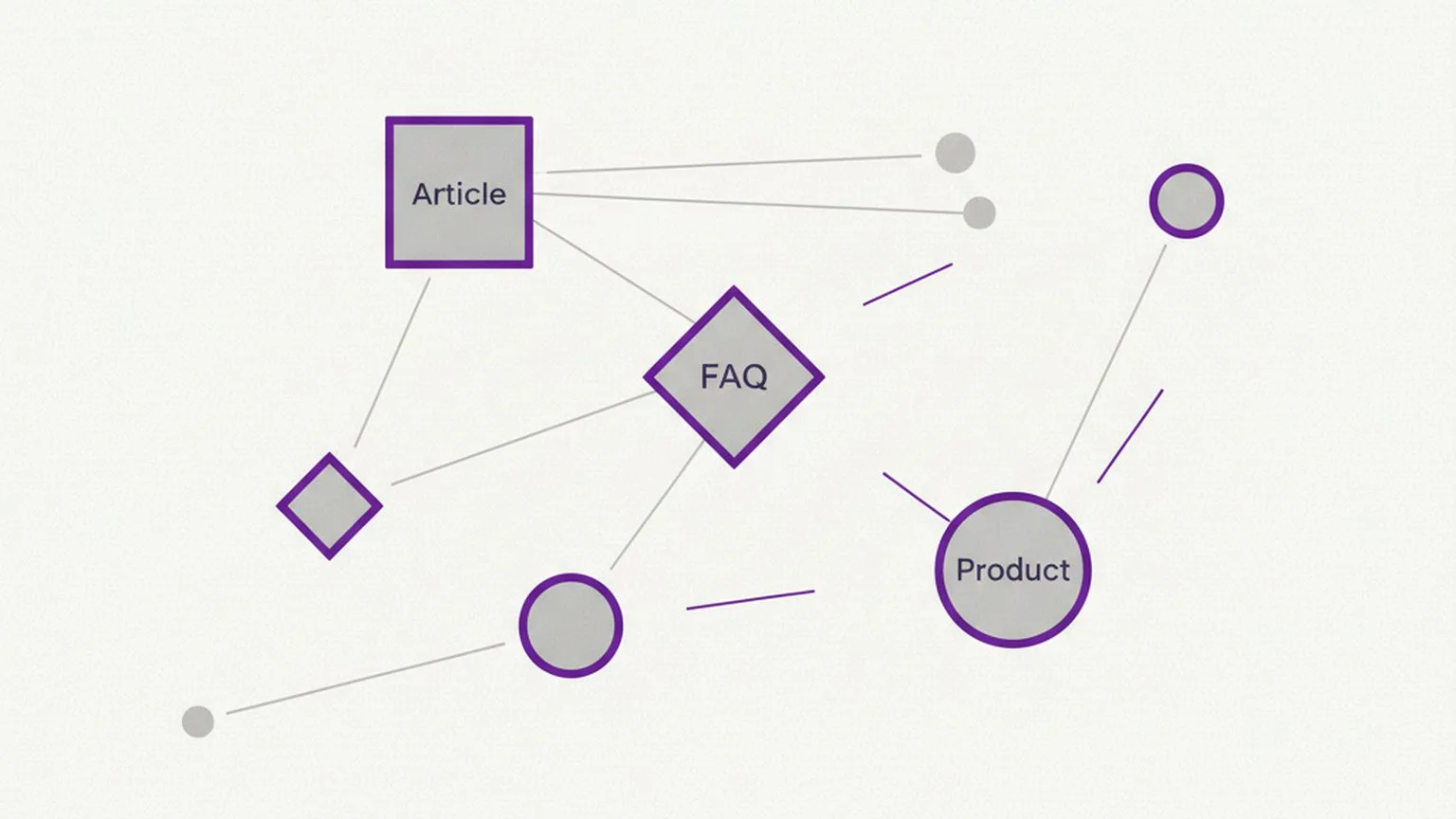
The types matter less than how they are wired together. A page should emit one @graph where:
- The Organization, WebSite, and Person (author) nodes each have a stable
@idreused site-wide. - The page entity (WebPage or Article) references those IDs rather than duplicating them.
- Sibling nodes such as FAQPage and BreadcrumbList sit alongside the page entity, not nested inside it.
How to ship all seven without a quarterly cleanup
Manually: one developer per template, a quarterly audit, and a lot of vigilance. It works until someone ships a new template.
Automatically: generate the graph per template from content type, so a new page inherits correct markup instead of waiting for someone to remember. That is what our LLM Discovery API does — it removes the drift problem rather than the authoring problem, which is the part manual processes keep losing.
Validation is non-optional
Before shipping any schema change, check it against:
- Google's Rich Results Test
- The schema.org validator
- Your own AI bot analytics, to confirm crawl depth does not drop after the change
Frequently asked
Is JSON-LD better than Microdata? Yes. Google and the major assistant crawlers all handle JSON-LD cleanly, and it keeps markup out of your presentation layer. Microdata is legacy. Can I have multiple schema graphs on one page? You can, but you should not. Wrap everything in a single@graph array with stable @id references so entities are declared once.
Does AI search read Review and AggregateRating? Yes, and they show up prominently in comparison answers — but only use them where you have genuine, verifiable reviews.
Will adding schema get my brand cited? No. Schema helps engines interpret a page correctly. Getting cited still depends on answering the question well and being corroborated elsewhere.
How often should schema be audited? Every deploy that touches a template, plus a quarterly full-site validation pass. Schema breaks silently, so a calendar reminder is the only thing that catches it.