What Pages Get Traffic From AI Search?
We analyzed anonymized data across roughly 150 client websites to understand which pages receive human traffic from AI search.
The pattern was consistent enough to pay attention to. Visitors coming from AI search usually did not start on homepages, pricing pages, or broad product pages. They landed on pages that answered a specific question, compared a specific category, explained a specific workflow, or gave them a specific asset they could use immediately.
That sounds obvious until you look at how most companies still structure their websites. The homepage gets the positioning work. Product pages get the commercial detail. Pricing pages get the conversion logic. The blog often becomes a mix of broad thought leadership, category explainers, and company opinions.
AI-referred visitors behaved differently in the data we reviewed. They arrived through pages that looked less like brand pages and more like answers.
A homepage is useful once someone wants to understand the company. A pricing page is useful once someone is evaluating the offer. A product page is useful once someone is comparing capabilities. But when the journey starts inside an AI assistant, the first page often needs to answer the question that triggered the recommendation in the first place.
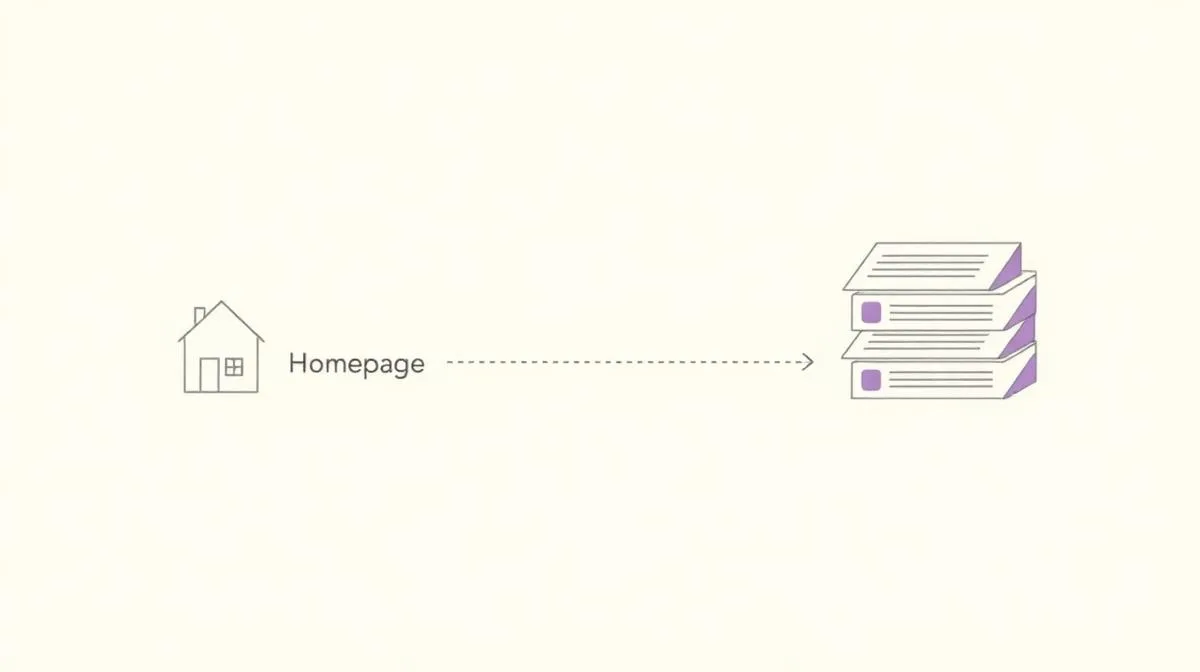
That is the main takeaway from this analysis: AI search traffic tends to land on answer-first pages.
What we analyzed
At LightSite AI, we reviewed anonymized traffic patterns across roughly 150 client websites to understand which page types were receiving human visits from AI-driven discovery channels.
This was not an academic study, and we are not claiming that one URL structure guarantees AI visibility. The goal was more practical: look across real websites, find the URLs receiving AI-referred human traffic, and identify the page patterns that appeared again and again.
The dataset included different industries and website types, which made the repeated patterns more interesting. The winning pages were not always the pages a marketing team would expect. In many cases, they were not the homepage, pricing page, or main product page. They were specific pages that matched a real question, task, workflow, or decision.
Answer-first pages showed the clearest pattern
The pages that appeared most often had a simple trait: they answered one thing clearly.
They were built around a specific audience, category, geography, tool, workflow, template, or vertical. They did not rely on broad market context before getting to the point, and they did not make the reader work hard to understand who the page was for.
That matters because AI search is shaped by prompts, not website navigation. People rarely ask an assistant to find a company homepage. They ask for recommendations, comparisons, instructions, templates, examples, and specific workflows.
A user might ask for the best spend management software for small businesses in the United States. Another user might ask how to automate GitHub issue creation with Claude Code. Someone else might ask for an invoice template, a CRM worksheet, or a checklist for a specific process.
The pages that matched those questions more directly were more likely to receive AI-referred visits.
The four page types that stood out
| Page pattern | Example slug | Why it worked |
|---|---|---|
| Audience and geography listicle | /blog/best-[category]-for-[audience]-in-[region] |
It matched recommendation prompts with buyer context. |
| Tool-named technical how-to | /blog/[verb]-[outcome]-with-[named-tool] |
It answered specific workflow questions with a named entity. |
| Template or utility page | /templates/[artifact] |
It solved a concrete task immediately. |
| Narrow vertical how-to | /how-[audience]-can-[action] |
It served specific audiences that broad publishers usually ignore. |
These formats are not new, and they are not tricks. They worked because the page’s purpose was obvious. A clear page is easier for a person to use, easier for a crawler to classify, and easier for an AI assistant to summarize or retrieve when answering a related prompt.
Pattern 1: listicles with audience and geography qualifiers
One of the strongest patterns was the audience and geography listicle.
A typical example looked like this:
Best spend management software for small businesses in the United States
The structure is simple:
best-[category]-for-[audience]-in-[region]
This works because the page gives the assistant enough context to understand the comparison. The category explains what is being evaluated, the audience narrows the buyer profile, and the geography adds constraints that can change which recommendations make sense.
A generic page about spend management software has to compete with every broad software list. A page for small businesses in a specific market gives the assistant a cleaner match for prompts that include company size, location, compliance, budget, or operating context.
This is especially important in B2B because buyers rarely ask completely generic questions. They add details about their company, industry, region, team size, tech stack, or budget. Pages that include those details from the start are better aligned with how AI search prompts are actually written.
For LightSite, the same logic applies to pages like best Generative Engine Optimization platforms, AI visibility tools for enterprise teams, or GEO platforms for B2B services. The point is not to stuff modifiers into a title. The point is to make the buyer context part of the page.
Pattern 2: tool-named technical how-tos
The second pattern showed up strongly with technical audiences. The best-performing technical pages often named a specific tool, product, library, or workflow.
A typical example looked like this:
Automating GitHub issue creation with Claude Code
The structure is direct:
[verb]-[outcome]-with-[named-tool]
This type of page behaves more like documentation than opinion content. A broad article about AI automation may help with brand positioning, but it does not answer a specific implementation question. A page about automating one workflow with one named tool is much easier to understand and much easier to match to a user’s intent.
The named tool gives the page a clear entity. The workflow gives it a reason to exist. The outcome makes the value obvious. Together, those signals help both humans and machines understand exactly when the page is relevant.
The editorial lesson is simple: give each article one clear named entity. That entity can be a tool, platform, framework, workflow, region, vertical, competitor, or template. Pages without a clear entity were usually harder to classify and weaker as AI search landing pages.
Pattern 3: template and utility pages
Template pages were one of the most underrated categories in the analysis.
Examples included URLs like:
/templates/invoice/templates/estimate/templates/crm/templates/checklist
These pages worked because they were useful immediately. A template page is not just an article; it is an asset someone can use, copy, download, customize, or complete.
That gives the page stronger intent than a regular blog post. Someone landing on an invoice template already has a task in mind. Someone landing on a CRM worksheet is probably comparing options or building a process. Someone using a calculator is already trying to make a decision.
This makes template pages valuable for both discovery and conversion. They can answer an informational prompt while also giving the visitor a reason to stay, interact, submit an email, or move deeper into the site.
For AI search, that combination matters. A template page can be retrieved as a useful answer, but it can also function as a conversion asset once the visitor lands.
The practical rule is straightforward: when your audience would download, copy, calculate, fill out, or reuse something, that asset probably deserves its own indexable page.
Pattern 4: narrow vertical how-tos
The fourth pattern was narrow vertical how-to content.
Examples looked like:
- How attorneys can use YouTube Shorts
- Resources for deaf interpreters
- How Shopify skincare brands can prepare for AI shopping
- How B2B SaaS companies can track AI search visibility
The structure is simple:
how-[audience]-can-[action]
These pages worked because they served audiences that broad publishers usually ignore. A generic article about using YouTube Shorts for marketing has a lot of competition. A specific guide for attorneys can talk about trust, compliance, client acquisition, examples, and the constraints of that profession.
The same principle applies across SaaS, services, ecommerce, healthcare, legal, education, and local businesses. When a user includes their role, industry, company type, or situation in a prompt, the narrower page becomes more useful.
This is why narrow vertical content can be surprisingly durable. It may not have massive search volume in traditional keyword tools, but it can match very specific prompts that AI assistants are asked to answer.
Slug patterns that appeared most often
Across the pages we reviewed, these URL structures appeared most often among AI-referred visits:
best-[category]-for-[audience]-in-[region]how-[audience]-can-[action][verb]-[outcome]-with-[named-tool]/templates/[artifact]
The slug itself is not the whole story. A page does not win because the URL follows a formula. The important part is the clarity behind the structure.
Each format forces the writer to define the audience, action, category, or asset. That makes the page easier to understand before a visitor even opens it. It also gives AI systems a cleaner way to classify the page and decide when it might support an answer.
In practice, vague URLs usually reflect vague pages. Specific URLs usually force better editorial decisions.
Slug patterns that appeared less often
The weaker patterns were usually broad thought-leadership structures.
Examples included formats like:
the-future-of-[topic]why-[topic]-matters[generic-topic]-strategy[abstract-noun]-in-[industry]
Those pages can still support brand authority, executive perspective, category education, and internal linking. They are not useless, and they should not automatically be removed.
They were simply less likely to be the first page receiving human traffic from AI search in the data we reviewed. The reason was usually specificity. A page about the future of AI search may be interesting, but a page about AI search visibility tools for B2B SaaS teams answers a much clearer question.
AI assistants need source material that helps complete the user’s task. Broad essays often require too much interpretation before they become useful in an answer.
Homepages and pricing pages still matter
Homepages, pricing pages, and product pages still play an important role in the journey. They validate the company, explain the offer, show proof, clarify packaging, and help convert users after discovery.
They also help AI systems understand the official source of truth for the brand. A weak homepage still creates a problem, especially if the company’s positioning, category, and proof are unclear.
The issue is that these pages were not usually the first page AI search sent visitors to. In many cases, the first landing page was an answer page. The homepage and product pages became more important after the visitor wanted to understand the company behind the answer.
So the takeaway is not that homepages are dead. It is that homepages are usually not enough.
Why answer-first pages fit AI search behavior
AI search is not just a different search result page. It is a different interface for intent.
Traditional search often begins with a keyword. AI search often begins with a full problem statement. The assistant tries to answer the problem, cite supporting sources, and recommend next steps. That changes which pages are useful.
A broad brand page may tell the assistant who you are. An answer-first page tells the assistant when your expertise is useful.
This distinction matters. If your site only has pages about your company, your product, and your category, you may be visible for brand and category prompts but absent from the specific workflow questions your buyers are asking.
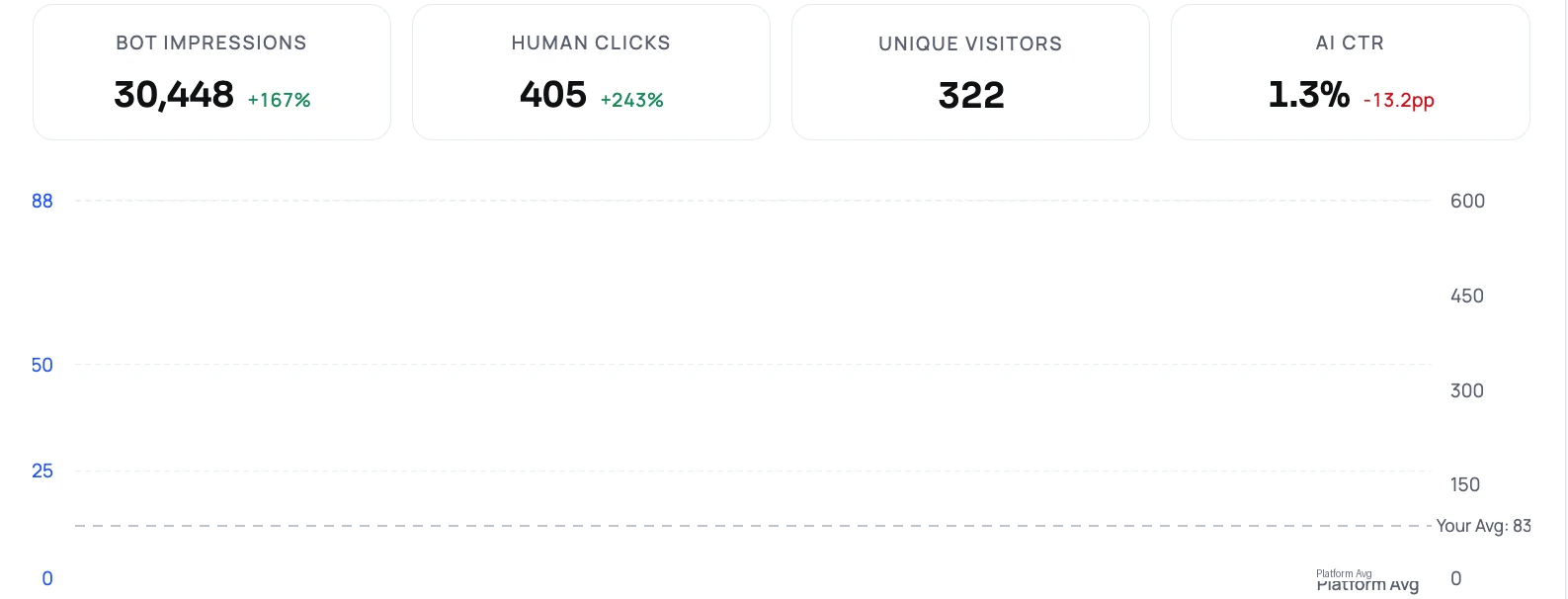
That is where AI Bot Analytics and AI Search Visibility Test become useful. You need to know which AI crawlers are visiting, which prompts mention you, and which pages actually receive AI-referred humans after the assistant sends someone to your site.
How to apply this without creating thin content
The wrong reaction is to generate hundreds of formulaic pages. That creates clutter, weakens editorial trust, and usually fails the human test.
The better approach is to identify specific questions where your company has real expertise, then build pages that answer those questions better than broad publishers can.
Start with the prompts your buyers already ask. Look at sales calls, support tickets, competitive deals, onboarding questions, internal search logs, product documentation, and analytics. Then ask whether your site has a page that clearly answers each high-value question.
If the answer is no, the next step is not just writing a blog post. It is deciding which page format best matches the intent:
- A comparison list for recommendation prompts.
- A technical how-to for workflow prompts.
- A template or utility for task-based prompts.
- A vertical guide for role-specific or industry-specific prompts.
Then make the page genuinely useful. Add definitions, examples, decision criteria, screenshots, checklists, caveats, and internal links to the next step. The format gets the page aligned with intent. The quality earns the click and keeps the visitor.
What this means for content strategy
Most teams still plan content around broad topic clusters. That is useful, but it is not enough for AI search.
AI search content strategy needs another layer: prompt-shaped pages. These are not random long-tail posts. They are pages mapped to real buyer questions and structured so the answer is obvious.
For a B2B company, that might mean:
- Best software by audience, vertical, company size, or region.
- How-to pages for named workflows and tools.
- Comparison pages that explain tradeoffs clearly.
- Templates, calculators, worksheets, and checklists.
- Vertical pages for high-fit industries.
This also changes internal linking. The answer-first page should not be a dead end. It should feed the visitor into the right commercial next step: a diagnostic, a product page, a comparison page, a demo, or a calculator.
For LightSite, that means research posts like this should point readers toward practical tools such as the AI Search Visibility Test, the GEO Checker, the AI Bot Analytics Platform, and the AI Content Agent.
How to measure whether this is working
Traditional SEO reporting can miss this behavior because AI search traffic does not always look clean in analytics. Referrers may be inconsistent. Some assistants cite without sending traffic. Some visits arrive through browsers, apps, or privacy-protected environments.
That means measurement should combine several signals:
- AI crawler visits to the page.
- Human sessions from known AI referrers.
- Mentions and citations in AI answers.
- Prompt-level visibility for target questions.
- Downstream visits to product, pricing, and conversion pages.
No single metric tells the whole story. But together, these signals show whether answer-first content is becoming discoverable, cited, visited, and commercially useful.
This is also where a basic rank tracker falls short. A keyword position does not tell you whether ChatGPT cited your page, whether Perplexity sent a visitor, or whether Claude crawled the URL before generating an answer. You need AI-native analytics, not just traditional search reporting.
The practical takeaway
In our analysis, AI-referred visitors were more likely to land on specific answer-first pages than broad brand pages. Homepages, pricing pages, and product pages still matter later in the journey, but they were usually not the first page that matched the user’s prompt.
That does not make answer-first pages a ranking factor. It makes them a practical content pattern for matching how people ask AI assistants for help.
If you want to improve AI search visibility, start by asking a simple question: does your site have pages that clearly answer the specific questions your buyers ask before they know your brand?
If the answer is no, the opportunity is not to publish more broad thought leadership. It is to build clearer, narrower, more useful pages that deserve to be recommended when those questions come up.