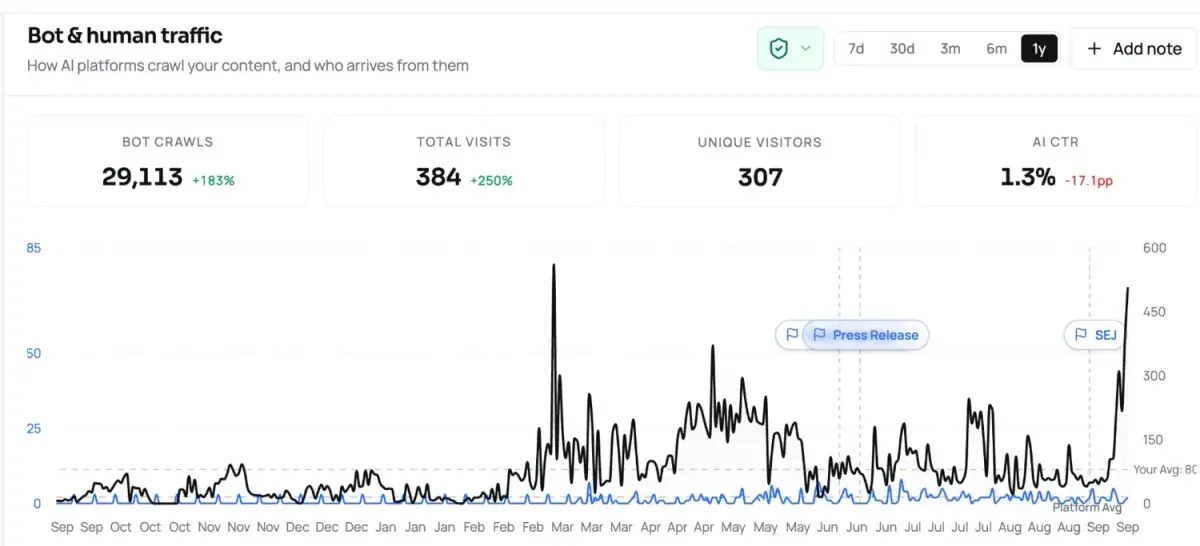
PerplexityBot and ClaudeBot: How to Track AI Crawlers
ClaudeBot vs PerplexityBot: two crawlers, two intents
ClaudeBot and PerplexityBot both show up in server logs, but they are there for very different reasons. ClaudeBot is Anthropic's training and retrieval crawler; PerplexityBot is closer to a live search-engine crawler that fetches pages in response to individual user questions. Knowing which is which — and separating them from spoofed traffic — is the first step toward tracking AI crawler activity in a way that actually informs strategy rather than just adding another dashboard.
ClaudeBot is Anthropic's training and retrieval crawler. Its presence on your site means Anthropic considers your content useful enough to ingest. The fetch pattern is patient and broad — Claude will revisit URLs over weeks, often without a tight correlation to a single user query. PerplexityBot is much closer to a live search engine crawler. It fetches in response to user questions. When you see PerplexityBot hit /pricing three times in a minute, it's very likely a user just asked Perplexity about your pricing. The latency from crawl to citation is short.User agents to watch
ClaudeBot/1.0 (+claudebot@anthropic.com)
PerplexityBot/1.0 (+https://docs.perplexity.ai/docs/perplexitybot)
Perplexity-User/1.0
Perplexity-User is the on-demand fetch initiated by a single user query. It's the closest thing to a "real-time citation" signal you'll get without instrumenting the AI engine itself.
What healthy traffic looks like
For a mid-market SaaS site running proper GEO:
- ClaudeBot: 50–500 hits/week across the site, weighted toward documentation and blog.
- PerplexityBot: spiky, correlated with topical news cycles and product launches.
- Perplexity-User: low volume but high signal — each one is an actual answer being assembled.
Why log filtering isn't enough
User-agent strings are trivially spoofable. A real platform verifies bots against published IP ranges:
- Anthropic publishes claudebot.txt listing valid CIDR blocks.
- Perplexity publishes its ranges via DNS and a docs page.
- OpenAI does the same for GPTBot and OAI-SearchBot.
Turning traffic into action
Three workflows that change once you can see this data: