Google Demystified AI Search. GEO Still Matters.
Google's new AI search guidance is useful because it removes some of the nonsense from the market. For Google Search, the message is clear. AI Overviews and AI Mode are not a separate game where special files, robotic AI writing, or synthetic tricks suddenly replace search fundamentals. Google says that, from its perspective, optimization for generative AI search is still optimization for the broader search experience.
That is good for everyone selling serious work in this category. It means the market can stop pretending that AI search visibility is won by uploading one magical file, rewriting every page for "LLMs," or flooding the web with artificial mentions. Those tactics were never a durable strategy, and Google is now making that much harder to defend.
The important nuance is that Google's guidance is about Google Search. It helps explain how website owners should think about AI Overviews, AI Mode, and inclusion in Google's search experiences. It does not fully explain how ChatGPT, Claude, Perplexity, Gemini, or future AI agents retrieve content, cite sources, browse websites, or use structured context.
A read from twelve years of selling into new tech categories: incumbents publish "guidance" at the exact moment a new channel starts pulling attention off their surface. It is rational behavior, not a conspiracy. IBM did it with cloud. Cable did it with streaming. The guidance is usually accurate for the incumbent surface and quietly misleading about the parts of the market moving elsewhere. Google's document is genuinely useful for Google Search. It is not a map for the reallocation happening around ChatGPT, Claude, Perplexity, and Gemini — and it is not meant to be.
Fake GEO is becoming easier to dismiss. Operational GEO is becoming more important.
Google is right to push back on AI search shortcuts
Google's guidance points website owners back to fundamentals: useful content, crawlability, accessibility, structured pages, and a good user experience. Google has also said that users in AI search experiences ask longer, more specific questions and continue with follow-up questions, which makes satisfying content and clear answers more important, not less important.
When companies treat AI search as a shortcut market, the work usually becomes worse. They add files nobody has proven major crawlers rely on. They rewrite content in a strange machine-first voice. They publish generic "best tools" pages with no real expertise. They talk about GEO like it is a separate loophole instead of a new operating layer on top of search, content, technical infrastructure, and brand authority.
If a GEO strategy depends on special files, AI-specific rewriting, or manipulative recommendation tactics, it deserves skepticism. That does not mean structured content, technical quality, and AI visibility work are useless. It means they should not be sold as hacks. The right framing is simpler: make the website easier to crawl, easier to understand, easier to verify, and easier for users and AI systems to use.
The llms.txt debate is only one small part of the story
The market spent too much time treating llms.txt like a shortcut. At LightSite, we tested it across client websites and did not see evidence that it attracts more AI bots or causes major AI crawlers to prefer those pages. It may still become useful in certain documentation or agent workflows later, but it should not be treated as the center of an AI search strategy today.
The same applies to the broader "write for AI" idea. Writing clearly helps both humans and machines. Writing artificially for AI usually damages authority, because the content becomes repetitive, generic, and detached from the buyer's real question. A good page should answer a specific need, use clear entities, support claims with proof, and make the next step obvious. That is not AI writing. That is good content.
Google Search is not the entire AI search market
This is the part most reactions to Google's guidance miss. Google's AI search guidance is important, but Google Search is not the whole AI discovery ecosystem. ChatGPT, Claude, Perplexity, Gemini, and emerging agents have different crawler behavior, retrieval paths, citation logic, browsing capabilities, and source preferences.
For a marketing team, the real question is not only whether a page can appear in Google AI Overviews. The broader question is whether AI systems can access the site, understand the brand, cite the right sources, compare the company accurately, and send qualified human visitors to pages that convert.
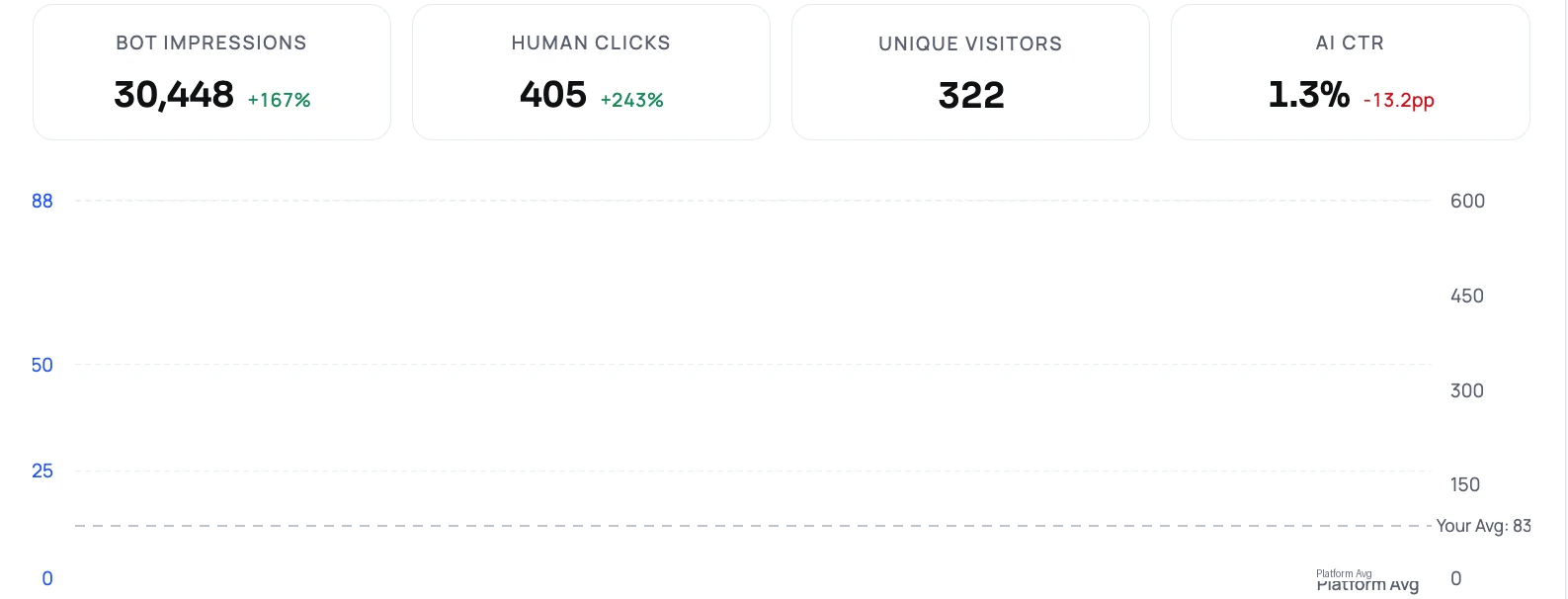
Teams need to know whether GPTBot, OAI-SearchBot, ClaudeBot, PerplexityBot, and other AI crawlers are reaching the pages that matter. That is exactly why an AI bot analytics platform is becoming a serious layer of the stack. Traditional rank tracking does not explain crawler behavior, and Google Search Console does not give a complete view of how non-Google AI systems interact with a website. For a fuller picture, see how LightSite teaches websites to speak with LLMs.
Real GEO is an operating layer, not a ranking trick
The strongest version of Generative Engine Optimization is not about tricking models into mentioning a brand. Real GEO is the operating layer that helps companies become easier to discover, understand, verify, and recommend across AI search experiences.
That includes technical foundations such as crawlability, metadata, canonicals, redirects, internal links, structured data quality, source-of-truth pages, and machine-readable business context. It also includes analytics work, such as AI bot monitoring, AI-referred visitor attribution, citation tracking, competitor visibility, and content gap detection. Across 150 client sites we found that AI-referred visitors landed on specific answer-first pages, not homepages — which is why execution and content gap analysis sit at the center of real GEO work.
Google keeps pointing back to fundamentals because those fundamentals still matter. LightSite agrees with that view. The difference is that many companies do not have the engineering support, technical SEO capacity, or internal ownership to implement and maintain those foundations quickly. A mid-market company may know that AI search matters, but the work falls between SEO, content, analytics, product marketing, and engineering. Everyone agrees the site should be clearer, more crawlable, better structured, and easier for AI systems to understand. Then the project gets stuck in a backlog.
LightSite fits there as an implementation, analytics, and execution layer. A machine-readable website for AI is not a magic parallel internet — it is a practical way to expose business facts, products, services, FAQs, proof points, and source-of-truth pages in formats that systems can parse more reliably. An LLM discovery API is not a ranking cheat — it is infrastructure that reduces ambiguity and makes important context easier to access.
The agentic web makes this more important, not less important
Google and Cloudflare are both moving toward a web where AI systems need cleaner ways to access and use websites. Google's AI Mode is positioned as an AI search experience that supports deeper reasoning, multimodal inputs, follow-up questions, and helpful links to the web. That direction makes websites more important as source material, even when the user journey does not look like a classic blue-link search session.
Google's WebMCP work points in a similar direction for agents: websites can expose capabilities that help agents interact with live web experiences more reliably, instead of forcing every agent interaction through messy visual browsing alone. Cloudflare's Markdown for Agents points to the same shift from another angle — see Cloudflare Markdown for Agents explained. This is exactly the design space the skills API for AI agents addresses.
These technologies are not the same as LightSite, and they should not be collapsed into one category. Google, Cloudflare, and LightSite solve different problems at different layers of the stack. But they all point to the same direction: websites are becoming sources, interfaces, and action surfaces for AI systems. That shift requires more than normal blog publishing. It requires technical clarity, crawler visibility, structured context, analytics, and execution.
Where LightSite fits after Google's guidance
Google's guidance makes LightSite's positioning cleaner. LightSite should not be described as a tool that hacks AI search. That framing is weak, and it creates the wrong expectation. LightSite should be described as the platform that helps companies operationalize AI search visibility across four connected layers:
- Technical implementation — deploys crawlability improvements, structured context, metadata fixes, redirects, and machine-readable signals faster.
- AI bot analytics — shows how AI crawlers and agents access the site, which pages they consume, and which paths they skip.
- AI visibility testing — tracks how the brand appears across AI search systems and which competitors are recommended instead. Try the AI search visibility test to see this in practice.
- Execution — turns gaps into content, comparison pages, structured assets, outreach opportunities, and technical fixes.
This is especially relevant for mid-market companies. They are large enough to care about AI search visibility, but they often do not have enough technical capacity to maintain every structured data, crawler analytics, and content execution workflow internally. Even large companies struggle with the same issue. The work is cross-functional, ownership is unclear, and engineering teams already have competing priorities. LightSite solves the execution gap by reducing the technical cost and turning AI search visibility into an ongoing operating system rather than a quarterly research project.
The right takeaway for CMOs and SEO teams
The takeaway from Google's guidance is not that GEO is fake. The takeaway is that shallow GEO is fake. Special files are not a strategy. AI-written filler is not a strategy. Manipulative recommendations are not a strategy. Rebranding basic SEO with new acronyms is not a strategy.
But AI search visibility still needs an owner. Someone needs to know how the brand appears in AI answers, whether the right pages are accessible, which AI crawlers are visiting, what sources are being cited, which competitors are winning, and what work needs to ship next. That is the actual GEO layer. It sits on top of SEO fundamentals, not instead of them.
What companies should do now
The practical response to Google's guidance is not to abandon AI search work. The practical response is to separate real operational work from shortcut tactics.
- Start with the technical foundation. Make sure important pages are crawlable, metadata is clean, redirects are sane, canonicals are consistent, and structured data reflects real business facts.
- Add AI search visibility measurement. Track how the brand appears across Google AI Search, ChatGPT, Claude, Perplexity, and Gemini. Look at competitors, citations, sentiment, source types, and prompts where the brand is missing.
- Inspect crawler behavior. Check whether AI bots are visiting the right pages, whether they return after content changes, and whether your site creates avoidable friction.
- Turn findings into execution. Build answer-first pages, comparison assets, structured FAQs, stronger proof pages, better internal links, and off-site authority signals that help AI systems verify the brand.
For a curated view of the tools that actually do this kind of work, see the best Generative Engine Optimization platforms comparison.
Final takeaway
Google's AI search guidance makes the category more honest. For Google Search, the foundations still matter: useful content, crawlability, technical quality, and trusted signals. The shortcuts are mostly noise, and the market should stop pretending otherwise.
For the broader AI search market, the problem is bigger than Google alone. Brands still need visibility across AI assistants, crawler analytics, citation tracking, competitor intelligence, technical implementation, and execution. That is where LightSite fits — not as a magic file generator, not as another passive dashboard, not as a tool that tells marketers to write strange content for machines. LightSite is the practical implementation and execution layer for AI search visibility across Google AI Search, ChatGPT, Claude, Perplexity, and the agentic web.
Want to see whether your site is ready for AI search beyond Google? Run the AI Search Visibility Test or check your technical foundation with the free Generative Engine Optimization Checker.