What Google's Generative AI Search Console Report Measures (and What It Doesn't)
Google's Generative AI performance report shows how often your site appears in AI Overviews and AI Mode, which pages appeared, and where those impressions came from. It is useful Google visibility data. It is not a complete AI-search analytics system.
Google rolled the report out worldwide on August 31, 2026. The Search report includes impressions, pages, countries, devices, and dates. Google also provides a separate report for generative features in Discover.
What the report can answer
Use it to see:
- whether Google generative-AI impressions are rising or falling;
- which canonical URLs appear most often;
- how visibility differs by country, device, and date;
- whether a page is present in AI Overviews or AI Mode at all.
That makes the report useful for finding pages to review, comparing periods, and checking whether technical or editorial changes coincide with more visibility.
What it cannot answer
The report is impressions-led. Google's current documentation does not list queries, clicks, conversions, revenue, or citation wording as report dimensions. It also does not measure visibility in ChatGPT, Claude, Perplexity, or other non-Google assistants.
An impression means a link to your site was shown. It does not prove someone visited, engaged, converted, or even noticed the citation. It also does not show whether an AI crawler fetched your content before the impression.
A practical measurement stack
Treat the report as one layer:
- Google visibility: Search Console generative-AI impressions by page, country, device, and time.
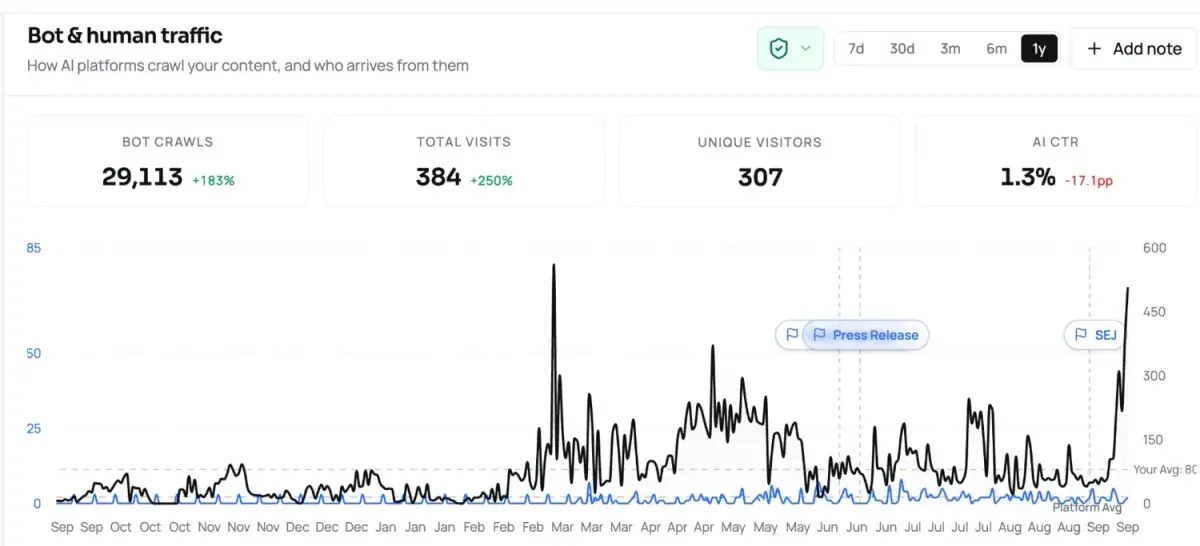
- Crawler activity: verified server-side requests from AI bots.
- Human visits: referral sessions from AI assistants where a referrer is available.
- Business outcomes: leads, sign-ups, purchases, or other conversion events.
Together, those layers separate visibility, machine access, human traffic, and outcomes. They should not be collapsed into one opaque "AI visibility score."
For the broader model, see LightSite's AI search measurement framework, the practical measurement guide, and the AI bot analytics platform.
The clean takeaway: use Google's report to measure Google generative-search visibility, then use site-side analytics to learn what happened next.