How Marketers Can Use AI Bot Traffic Data to Find Demand Earlier
Twelve years of selling new tech categories taught me one thing about early-stage channels: the useful data is always sitting in a log file that no one on the marketing team has permission to open. AI bot traffic is exactly that data today. Engineering sees it as noise, marketing has never seen it at all, and the operators who bridge the two are quietly building the next visibility advantage.
Before the how, one framing choice. I am not going to argue GEO vs SEO in this piece — that debate is a distraction. GEO is a reallocation of resources, the same way cloud was a reallocation of infrastructure spend that everyone initially dismissed as "just someone else's data center." The reallocation moves budget toward community engagement, authority building, and machine-readable structure — the parts of marketing most teams are least practiced at. Bot traffic data is how you prove that reallocation is working before the rest of the org can see the outcome.
AI systems now visit websites for several different reasons. Some crawlers collect public information that may contribute to future model development. Some index pages for AI-powered search results. Some fetch a specific page because a user asked a question. Some agents interact with product pages, search tools, account flows, and checkout experiences. These visits are becoming a new top-of-funnel signal.
An AI bot request does not mean that a model learned your content. It does not mean that your brand will appear inside an answer. It does not mean that a citation or conversion will follow. However, it does tell you something important: a machine working somewhere inside the AI ecosystem found a reason to access your content.
AI bot traffic is most useful when connected with human visits, conversions, citations, content changes, and off-site campaigns — not when watched in isolation.
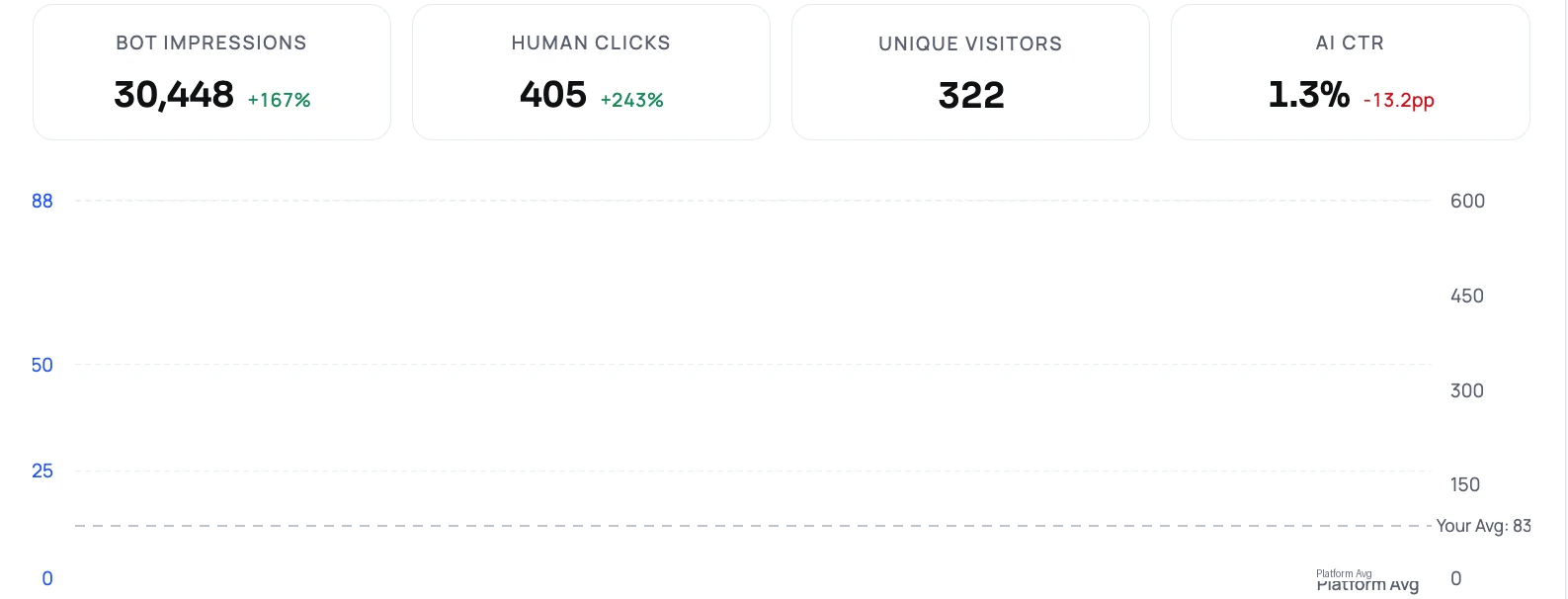
If you want to see this in action against your own domain, the LightSite AI bot analytics platform separates training crawlers, AI-search crawlers, user-triggered fetchers, and agents, then connects that activity with human visits and conversions.
AI Bot Traffic Is Becoming a Real Marketing Signal
The broader traffic shift is already visible. HUMAN Security reported that AI-driven traffic grew by 187 percent during 2025, with traffic from AI agents and agentic browsers growing 7,851 percent in the same period. Training crawlers still represented the largest share, but real-time retrieval systems and agents expanded quickly.
TollBit reported another useful benchmark from its publisher network: by the final quarter of 2025, publishers were seeing one AI bot visit for every 31 human visits — compared with roughly one AI bot visit for every 200 human visits at the start of the year.
Those numbers do not mean every company should chase crawler volume blindly. They mean marketers need a better way to understand a visitor category that barely existed inside their dashboards two years ago.
The simplest comparison comes from paid advertising. An advertisement impression does not generate revenue by itself, but impressions become useful when connected with clicks, landing pages, conversions, audience segments, and creative variations. AI bot traffic works the same way. A single crawler request is weak evidence; a pattern of requests, landing pages, extraction paths, human referrals, citations, and conversions becomes valuable intelligence.
Founder note (Stas Levitan, LightSite): A pattern I keep seeing in the 150+ AI-search conversations I have had at LightSite this year: the marketing teams who move fastest are the ones who already had to justify unfamiliar metrics to a skeptical CFO. If you learned how to defend MQL definitions, pipeline hygiene, or attribution windows, you already have the muscle to defend bot analytics. If your team still runs on "AI traffic is up 40 percent" screenshots, it is not analytics — it is a vanity chart with a new label.
Different AI Bots Perform Different Jobs
Marketers should avoid grouping every AI-related request under one label. Major AI companies operate different bots for different purposes, and the meaning of a request changes depending on which system made it.
| Bot category | What it does | What marketers can infer |
|---|---|---|
| Training crawler | Collects public web content that may contribute to future model development | Your content was accessed as a possible data source |
| AI search crawler | Indexes or analyzes pages for search and retrieval experiences | Your content may become eligible for AI-powered search visibility |
| User-triggered fetcher | Opens a page after a user asks an assistant for information | A real user request created immediate retrieval demand |
| AI agent / agentic browser | Navigates, searches, compares, or performs actions across a website | Your website may need structured paths that support task completion |
OpenAI documents GPTBot, OAI-SearchBot, and ChatGPT-User as separate systems with different purposes. Anthropic publishes a similar separation for ClaudeBot, Claude-SearchBot, and Claude-User. Perplexity also separates its search crawler from its user-triggered fetcher. Google-Extended is a control token used inside robots.txt — not a crawler in its own right.
The useful question is not simply, "How many AI bots visited our website?" The better question is: which systems visited, why did they visit, what did they access, and what happened afterward?
Model Weights Should Not Be Confused With Crawler Priorities
Marketers sometimes use the word "weights" when describing crawler behavior. That explanation creates confusion. Model weights are numerical parameters learned during model training. They influence how a trained model processes information and generates outputs. They are not instructions telling a crawler to visit more conversations, more product pages, or more factual sources during a particular week.
AI companies can still change their collection priorities. They operate separate crawlers, adjust crawl budgets, change retrieval rules, prioritize certain industries, or increase activity before major product releases. Those operational decisions can produce visible traffic patterns. But marketers should describe those patterns carefully: you can observe that a particular crawler increased activity across product pages; you cannot conclude that the company assigned a higher model weight to product information without direct evidence.
Why Bot Logs Can Be More Useful Than Prompt Tracking Alone
AI visibility tracking remains useful. Marketing teams should test whether assistants mention their brand, cite their pages, describe their positioning correctly, and recommend competitors instead. However, prompt tracking has a natural limitation: generated answers can change between sessions, models, locations, accounts, and browsing modes. The output is valuable benchmarking data, but it should not be treated as a perfect record of reality.
Server-side bot logs provide a different kind of signal. A server log records that a request happened — which path was accessed, when the request arrived, which user agent identified itself, and whether the server returned a usable response. That does not make bot traffic unbiased: crawler schedules still depend on platform priorities, crawl budgets, technical rules, access policies, and detection quality. Some bots identify themselves clearly, while other automated requests may be harder to classify reliably.
Still, bot behavior provides something marketers badly need: observable machine activity. The strongest AI-search analytics strategy combines both layers — what assistants say about your brand, and how AI-related systems actually interact with your website.
Five Marketing Questions That AI Bot Traffic Can Answer
1. Which off-site campaigns attract machine attention?
Marketing teams already invest in PR, backlinks, community posts, listicles, podcasts, and editorial mentions. The difficult question is whether any of those activities change how AI systems discover the brand. Bot traffic creates an early feedback loop.
Imagine your company earns a contextual mention inside a useful Reddit discussion. During the following week, several AI crawlers revisit your homepage, product pages, FAQ content, and comparison pages. That pattern does not prove the Reddit mention caused the crawl increase — but it gives your marketing team a useful hypothesis. You can compare that campaign window against previous activity, measure crawler diversity, inspect the pages that received new attention, and watch whether human AI referrals or brand mentions change afterward.
A five-thousand-dollar press release may produce fewer useful machine visits than one genuinely helpful community answer. A contextual backlink inside a technical guide may attract more relevant retrieval activity than a generic directory placement. The advantage comes from measuring the difference.
2. Which pages help AI systems understand your business?
Crawler volume alone can create false confidence. A bot may visit your website and still fail to find useful information. Marketers should inspect which pages attract repeated access, which paths lead to deeper exploration, which endpoints return meaningful content, and which sections appear to be ignored. A machine-readable website for AI can make company context, products, FAQs, proof points, and categories easier for automated systems to retrieve.
In one LightSite analysis later published by Conductor, ChatGPT activity increased after a machine-readable skills manifest was introduced across customer websites. ChatGPT traffic increased from 2,250 requests to 6,870 requests during the measured window. Q&A endpoint usage increased from 534 requests to 2,736 requests. Path diversity declined from 51.6 percent to 30 percent — suggesting some systems may behave more purposefully after they discover reliable machine-readable paths.
3. Which content formats create human AI traffic?
Across anonymized LightSite client data, AI-referred visitors often land on pages that answer a specific question directly. They do not always begin on homepages, pricing pages, or generic product pages. Stronger landing pages repeatedly include: listicles containing an audience and geography qualifier; technical tutorials naming one specific tool; templates, calculators, and utility pages; and narrow how-to guides serving overlooked audiences.
A page titled "Best Spend Management Software for Small Businesses in the United States" gives an assistant a clear reason to retrieve it. A page titled "The Future of Spend Management" may sound polished, but it answers a weaker question.
4. How long does machine discovery take to become visible?
Marketers want a clean timeline between publishing content and appearing inside AI answers. That timeline does not exist yet. Different models refresh differently, search-enabled assistants retrieve fresh information differently, and third-party citations, brand authority, technical access, and user location all affect the result. In one internal LightSite analysis across customer accounts:
| Time from observed crawl to tracked AI mention | Share of customers |
|---|---|
| Within 14 days | ~17% |
| 15–30 days | ~6% |
| 31–90 days | ~19% |
| More than 91 days | ~39% |
| No tracked mention appeared | ~19% |
This is not a causal measurement. It does show why marketers need patience, historical tracking, and multiple data sources. A single weekly prompt test will miss most of the story.
5. Which platforms prefer different types of content?
Across a LightSite sample of 6.2 million datapoints, URLs containing /faq represented approximately 1.1 percent of overall requests. The platform-level differences were substantial:
| Platform | Share of requests reaching /faq URLs |
|---|---|
| Perplexity | 7.1% |
| Amazon Q | 6.0% |
| DuckDuckGo AI | 2.1% |
| ChatGPT | 1.8% |
| Meta AI | 1.6% |
| Claude | 0.6% |
| ByteDance AI | 0.1% |
| Gemini | 0.1% |
Different systems may discover, interpret, and reuse website structures differently. A strong AI-search program should measure platform-level behavior rather than assuming one optimization works everywhere.
The Marketing Dashboard Should Connect Machines With Humans
The biggest mistake is building another isolated dashboard. Bot analytics should not sit alone beside your server logs. Mention tracking should not sit alone beside your prompt library. Human referral traffic should not sit alone inside Google Analytics. The useful view connects the full chain — off-site activity, bot discovery, site usability, AI visibility, human behavior, and business impact.
The marketer who wins will not be the person watching one number. The winner will connect machine discovery with content performance, brand visibility, human visits, and conversion behavior. This is the practical case for treating AI bot analytics as part of the marketing stack.
A Practical Weekly Workflow for Marketing Teams
Start by separating bot traffic by purpose and platform. Track training crawlers, AI-search crawlers, user-triggered fetchers, and agentic activity independently whenever your detection quality supports that distinction. Then compare behavior across campaign windows — look at the week before a PR placement, community post, backlink, or content launch and compare that baseline with the following weeks. Track request volume, crawler diversity, landing pages, deeper paths, endpoint usage, response status, and human AI referrals.
Next, review the pages receiving repeated machine attention. Ask whether those pages answer a clear buyer question, whether the first paragraph provides a direct answer, and whether product facts, FAQs, proof points, and comparisons are easy to retrieve. Finally, connect behavior with commercial outcomes: track whether AI-referred visitors arrive on the same pages, whether those visitors convert, and whether citations, recommendations, and brand descriptions improve over time.
What AI Bot Traffic Does Not Prove
A crawler visit does not prove your content entered a training dataset. A training crawler request does not guarantee that your content influenced a future model. A search crawler visit does not guarantee a citation. A user-triggered fetch does not guarantee a conversion. A crawl spike after a campaign does not prove causality. Bot identity can also be imperfect — automated requests can be spoofed, proxied, or routed through third-party infrastructure. High-quality analysis should verify identity where possible and label uncertain traffic separately.
Methodology note
LightSite data referenced in this article was aggregated across anonymized customer domains. Bot requests were classified using identifiable platform signals where available. The analysis is directional and should not be interpreted as proof that crawling caused later mentions, citations, or conversions.
Reading Bot Data Through Brand Authority Architecture
The framework we use internally — and coined publicly — is Brand Authority Architecture. Bot traffic patterns map cleanly onto its layers. Entity crawlers repeatedly hitting your About and comparison pages tell you machines are still resolving who you are. Search bots reaching FAQ and answer pages tell you the answer layer is working. User-triggered fetchers on product detail pages tell you real buyers are asking. When those layers are silent, the fix is rarely more content — it is usually more presence in the communities and third-party venues that feed the machines in the first place.
This is also where AI CTR, another term we introduced, gives the data a commercial edge. Crawls without downstream referrals is a leak between discovery and citation. High referrals from low crawl volume is a signal that a small number of pages are punching above their weight and deserve amplification. Reading bot logs without those two lenses tends to produce interesting charts and no decisions.
The Competitive Advantage Comes From Seeing Earlier
Most marketers wait for traffic changes, pipeline changes, or lost deals. By that point the underlying discovery shift may already be months old. AI bot analytics gives teams an earlier view: which content machines discover, which campaigns attract attention, which website paths support retrieval, which platforms behave differently, and which AI-referred visitors eventually convert.
You can publish the missing comparison page earlier. You can improve the FAQ content that agents repeatedly access. You can strengthen the structured layer behind a product catalog. You can stop funding off-site campaigns that generate noise without useful machine discovery. AI bot traffic is not a vanity metric — it is the beginning of a new marketing feedback loop.
Test how AI systems access your website
Run the free Generative Engine Optimization checker to see how crawlable and understandable your website is for AI systems.
Test Your Website for AI Crawlability Check Your Brand Visibility in AI SearchFrequently Asked Questions
What does AI bot traffic mean for marketers?
AI bot traffic records automated requests from systems associated with model training, AI search, user-triggered retrieval, and agentic browsing. Marketers can use those requests as early behavioral signals when they connect them with content performance, AI visibility, referrals, and conversions.
Does an AI crawler visit mean my content trained a model?
No. A crawler visit only proves a request reached your server. The meaning depends on the crawler category and the platform operating it.
Can AI bot traffic predict future AI mentions?
It can support directional analysis, but it cannot reliably predict future mentions on its own. Strong analysis combines crawl behavior with content changes, citations, prompt tracking, AI referrals, and conversion data.
Which AI bot metrics should marketers track?
Track crawler purpose, platform, request volume, page paths, response status, crawler diversity, extraction success, repeated visits, human AI referrals, and later conversions.