Measuring GEO ROI Without Google Analytics
The measurement gap
Generative Engine Optimization (GEO) creates value before Google Analytics can see it. AI engines fetch your pages, cite them, and influence buying decisions before a click ever lands in GA4. By the time the user converts, the attribution is gone. CMOs trying to justify GEO budget against a GA4 dashboard hit a wall almost immediately.
The wall isn't real. The metrics for GEO ROI exist; they just don't live in Google Analytics.
Five metrics that actually measure GEO
1. AI crawler hit volume
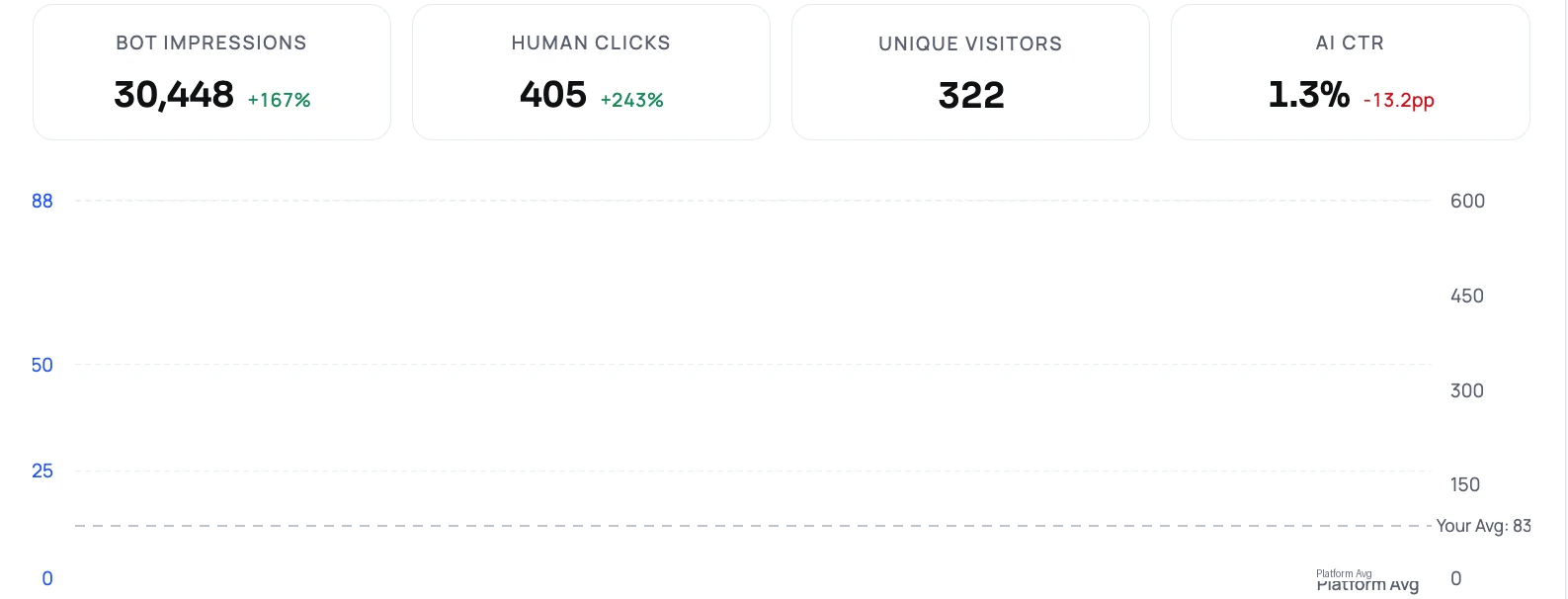
The most basic measurement: how many times did GPTBot, ClaudeBot, PerplexityBot, OAI-SearchBot, and Bingbot fetch your money pages this week? A working AI bot analytics platform gives you this in real time. A flat or declining trend is the leading indicator that something broke.
2. Citation rate in AI answers
A mention tracker queries AI engines on a defined keyword list and checks whether your brand appears in the answer. Track citation rate per keyword cluster, not per query — single-query noise is high.
3. Schema extraction coverage
The percentage of your URLs that emit valid, AI-readable JSON-LD. With a dynamic schema layer this should sit near 100%. With hand-rolled schema it usually drifts to 30–60% within a year.
4. Branded query volume in AI engines
Hard to measure directly, but a strong proxy: branded search volume in Bing (Bing Webmaster Tools surfaces Copilot-driven queries) and Reddit/LinkedIn brand mention frequency. Both correlate tightly with AI assistant exposure.
5. Revenue from AI-influenced sessions
The holy grail. Tag inbound sessions whose referrer or first-touch text matches "ChatGPT," "Perplexity," "Claude," "Copilot," and pipe that to your CRM. Most companies see 3–8% of pipeline carrying an AI touchpoint by late 2025; that share is growing.
A simple monthly board view
A one-page GEO scorecard that holds up in a board meeting:
- AI crawler hits (this month vs. last month, broken down by engine)
- Top 10 keyword citation rate (% of queries that cite us)
- Schema coverage (% of indexable URLs with valid JSON-LD)
- AI-influenced pipeline ($) and conversion rate vs. baseline
What not to measure
- "GA4 organic traffic" attributed to GEO. It doesn't work; AI traffic doesn't fire the GA tag.
- Vanity rank tracking on AI engines. Rank is unstable and varies by user context.
- Single-query citation snapshots. Use distributions, not points.
Setting baselines
Before making changes, capture two weeks of bot analytics, citation rates, and schema coverage. After the GEO program ships, compare 30/60/90-day deltas. Without a baseline, every internal conversation about ROI degenerates into "feels different."