Why ChatGPT Doesn't Recommend Your Business (And How to Fix It)
The first sign of an AI search problem
For many companies, the first sign of an AI search problem is surprisingly simple.
Someone asks ChatGPT for the best solutions in your category. Your competitors appear. Your company doesn't.
At first, most teams assume it's a content problem. They publish more blog posts, create more landing pages, and expand their SEO strategy. But AI recommendation systems don't work like traditional search engines. Ranking in Google and being recommended by ChatGPT are not the same thing.
In this guide I explain why AI assistants overlook certain companies, what signals influence recommendations, and how to improve your visibility across ChatGPT, Claude, Gemini, and Perplexity. For the deeper strategic playbook behind these tactics, read the complete playbook for lean marketing teams building AI search authority.
A note from me before we dig in
I worked for many years with top-level CMOs on large datasets, and I was there at the beginning of when SEO managers started using Similarweb for real decision-making and benchmarking themselves against competition. A lot has changed since then.
My honest view today: SEOs should not be looking at keywords. AI search is far more a brand-building effort than anything else right now, and many SEOs simply don't have the skills that are needed for it. AI search is a brand and C-level problem, not an SEO or content problem.
I speak with a few existing customers and new prospects every day. I hear their pain points, I see what is actually working and what is not, and I watch how different parts of the industry adapt to it very differently. Most of what follows comes directly from those conversations.
Why ChatGPT recommends some companies and ignores others
When a user asks "What is the best CRM for startups?" or "What are the top AI SEO platforms?", ChatGPT is not pulling a ranking page. It synthesizes information from multiple sources and generates an answer based on what it believes are the most relevant, trusted, and well-understood companies.
Recommendation visibility depends on far more than keyword rankings. AI systems look for signals that help them understand:
- What your company does
- Which category you belong to
- How trustworthy your brand appears
- Whether third-party sources mention you
- How often you are discussed alongside competitors
The five most common reasons ChatGPT doesn't recommend your business
1. AI doesn't fully understand your company
Many websites are designed for humans, not AI systems. Visitors may understand your value proposition immediately. AI models often don't.
Common issues include unclear positioning, inconsistent messaging, missing entity relationships, weak structured data, and poor category definition. If ChatGPT cannot confidently determine what category you belong to, recommendations become less likely. A dynamic LLM Discovery API closes this gap by emitting valid JSON-LD on every URL so models get a clean, citable fact instead of a guess.
2. Your competitors have stronger entity signals
AI systems rely heavily on entities. An entity is the AI's understanding of a company, product, person, or concept. Companies with stronger entity footprints tend to receive more recommendations.
Strong entity signals include structured data, knowledge graph connections, category associations, consistent descriptions across the web, and authoritative citations. In almost every prospect call I take, this is the gap I see first — our LLM SEO tool is built around measuring and improving exactly these signals.
3. You lack third-party authority
AI systems don't trust only your website. They trust the broader web. When evaluating brands, large language models lean on review platforms, industry publications, comparison articles, directories, analyst coverage, and community discussions.
If your competitors appear across these sources while your brand remains invisible, recommendation frequency can suffer. The fix is not "more PR" — it is systematic third-party presence on the surfaces LLMs already trust.
4. Your website isn't optimized for AI consumption
Traditional SEO focuses on rankings. AI search introduces a different challenge: your content must be easy for language models to interpret, classify, and reference.
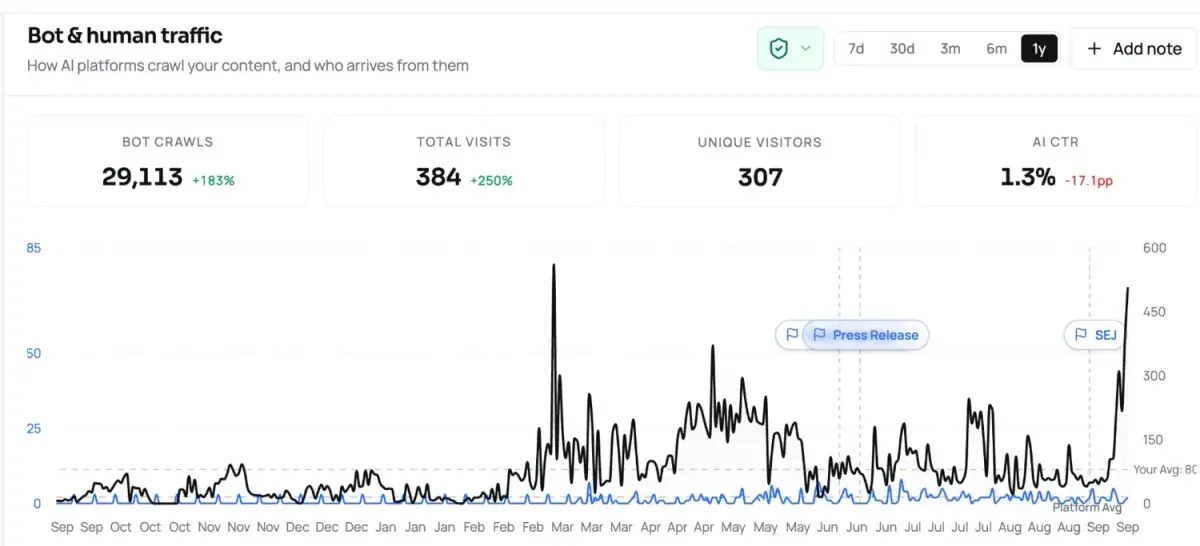
Common AI-readiness issues include missing schema markup, weak content structure, fragmented topical coverage, poor internal linking, and inconsistent entity references. The best way to know whether engines are actually reaching your pages is to measure AI bot traffic, not just mentions — if GPTBot, ClaudeBot and PerplexityBot aren't crawling, no amount of content will surface you.
5. Nobody is actually implementing improvements
This is where many companies get stuck. They already know what needs to be fixed. They have audits, recommendations, visibility reports, strategy documents. But implementation remains trapped inside engineering backlogs and marketing roadmaps. Meanwhile, AI systems keep learning from outdated information.
The problem is no longer discovering what to improve. The problem is executing improvements consistently. The companies pulling ahead in my conversations are the ones who treat AI visibility as a weekly shipping cadence, not a quarterly report.
Why this is a C-level problem, not an SEO problem
The teams winning here treat AI search the way they treat brand. The companies losing here treat it the way they used to treat keyword rankings.
What that looks like in practice from the conversations I have every week:
- The CEO and CMO own the narrative — who you are, what category you own, who you beat and when.
- Product, design and content all repeat the same entity story consistently across every surface.
- SEO and engineering execute the technical layer, but they are not setting the strategy.
How to check whether ChatGPT understands your business
Start with a simple exercise. Ask ChatGPT:
- What does [Company Name] do?
- Who are [Company Name]'s competitors?
- What category does [Company Name] belong to?
- When should someone choose [Company Name]?
- What alternatives exist to [Company Name]?
How to improve AI recommendations
The companies gaining visibility in AI search typically focus on five areas:
AI search is becoming an execution problem
Most companies no longer lack recommendations. They lack implementation. The next generation of AI search optimization will not be won by teams producing more reports. It will be won by teams that can turn recommendations into completed work. As AI search continues growing, execution speed becomes a competitive advantage.
How LightSite helps
LightSite helps companies improve visibility across ChatGPT, Claude, Gemini, and Perplexity by identifying AI visibility gaps and executing approved improvements. Instead of generating another dashboard full of recommendations, LightSite focuses on implementation. Your team approves. LightSite executes.
From AI readiness and structured data to content improvements and authority-building initiatives, LightSite helps companies become easier for AI systems to understand, trust, and recommend.
Ready to see how AI systems understand your business? Start with a free AI visibility assessment and discover the gaps preventing your company from being recommended.
Frequently asked
Why doesn't ChatGPT recommend my business? Usually because the model cannot confidently classify your category, your entity signals are weaker than competitors, or third-party sources rarely mention you alongside the right comparisons. How do I check what ChatGPT knows about my brand? Ask it directly — "what does [brand] do", "who are [brand]'s competitors", "when should someone choose [brand]" — and look for missing categories, wrong positioning, or competitor bias. What's the fastest way to improve AI recommendations? Fix entity clarity and structured data first (so models stop guessing), then layer in comparison content and authoritative third-party mentions. Is this different from traditional SEO? Yes. Ranking on Google rewards keywords and links; being recommended by ChatGPT rewards entity clarity, trust signals, and how often you are discussed alongside the right competitors.Related reading
- Lean Marketing Team Playbook for AI Search Authority — the complete playbook.
- AI Bot Analytics Platform — measure bots and humans, not just mentions.
- LLM SEO Tool — entity and structured data optimization.
- Four Trust Signals That Make AI Recommend Your Brand First
- How to Get Your Brand Cited by LLMs