Why Marketers Should Track AI Bot Traffic to Their Website
I have spent twelve years selling new categories of technology, and the pattern is always the same: the earliest signal of a new channel shows up as weird, unexplained traffic in a log file long before it shows up as a line in anyone's budget. AI bot traffic is that signal today. Most marketing teams have never opened it.
One reframe before the data. GEO vs SEO is not a war, it is a reallocation of resources. In the early cloud days, every enterprise argued that "cloud is just someone else's data center" until the budget quietly moved anyway. GEO is the same shift. It moves marketing attention toward the work most teams are least comfortable with: community engagement, authority building, and the machine-readable substrate underneath both. Tracking AI bot traffic is where that reallocation becomes visible first.
AI crawlers, search bots, retrieval systems, and browsing agents are already visiting websites at growing scale. They read content, revisit selected pages, retrieve fresh information, explore structured endpoints, and increasingly take actions on behalf of users. That traffic is not a vanity metric — it is becoming a machine-level top-of-funnel signal.
A single bot request does not prove your company will be cited or recommended. But patterns in bot traffic reveal whether machines can discover your content, whether they can access it efficiently, and whether your marketing campaigns are creating new machine attention.
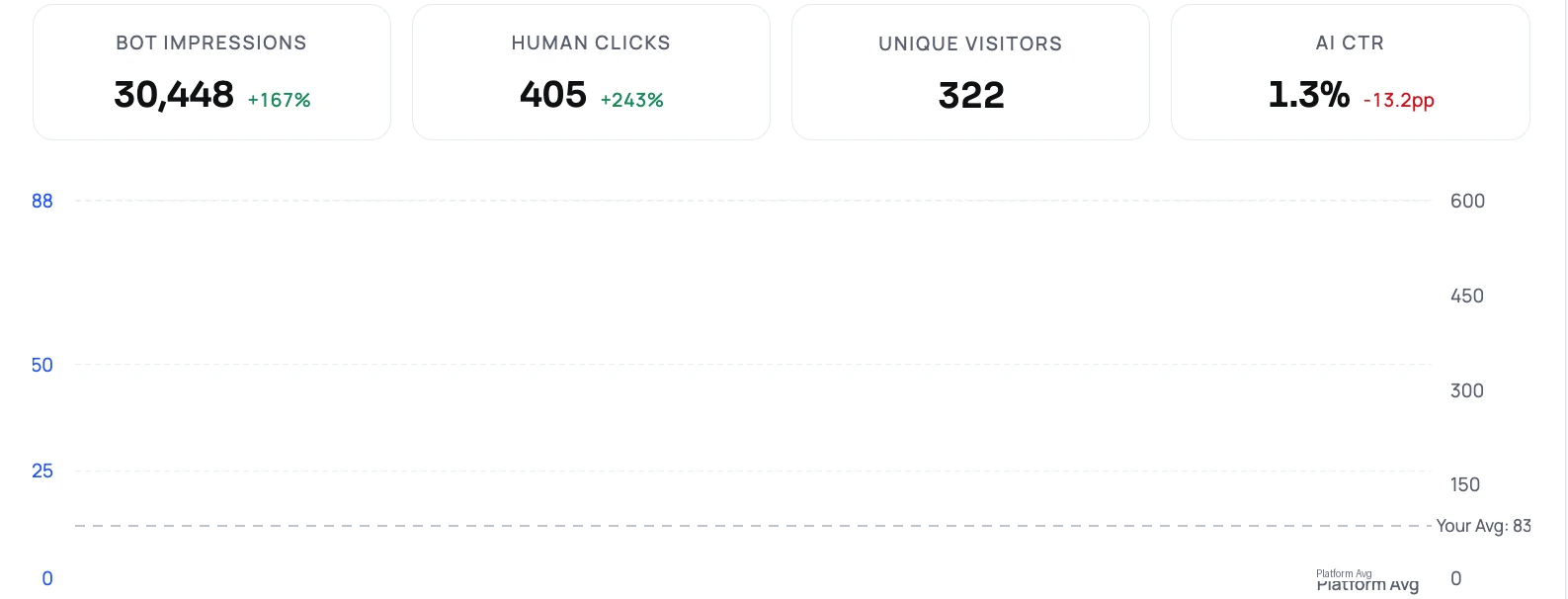
Marketers should start tracking those patterns before competitors do. The LightSite AI bot analytics platform shows why marketers should track AI bot traffic by separating training crawlers, AI-search crawlers, user-triggered fetchers, and agents — then connecting that activity with human visits and conversions.
AI Bot Traffic Is Growing Faster Than Most Marketing Teams Realize
The shift is already visible across the internet. HUMAN Security reported that AI-driven traffic grew by 187% during 2025, while traffic from AI agents and agentic browsers grew 7,851% in the same period. The absolute volume of agent traffic started from a small base, but the direction matters. AI systems are not only reading websites anymore — they are increasingly navigating product pages, searching catalogs, accessing account flows, and completing tasks.
HUMAN found that 77% of observed agentic activity occurred on product and search pages, with additional activity on account pages, authentication flows, and checkout pages. TollBit reported another useful benchmark: by the final quarter of 2025, publishers were seeing one AI-bot visit for every 31 human visits, compared with roughly one for every 200 at the start of the year.
These numbers do not mean every website should chase crawler volume blindly. They mean marketers need to understand a new type of traffic that rarely appears inside their standard analytics dashboards.
Founder note (Stas Levitan, LightSite): I have spent most of the last decade selling into CMOs and VPs of Marketing across security, DR, and CDN — categories where the buyer only trusts numbers they can trace back to a decision they made. Bot analytics passes that test in a way most AI-search dashboards do not. It is measurable server activity, it maps to campaigns you actually ran, and it does not require anyone to believe a prompt-share chart on faith.
AI Bot Traffic Is Similar to Advertising Impressions
An advertisement impression does not generate revenue by itself. However, impressions matter when you connect them with clicks, landing pages, conversions, audience segments, and campaign costs. A large number of irrelevant impressions can indicate wasted budget. A smaller number of highly relevant impressions can produce better results.
AI bot traffic works in a similar way. A crawler request alone is weak evidence. A pattern of bot requests becomes useful when you connect it with the pages visited, the amount of content delivered, the crawler identity, the campaign that preceded the visit, later AI-search mentions, human referrals from AI assistants, and eventual conversions. The value does not come from watching one number rise — it comes from understanding the story behind the traffic.
Not Every AI Bot Performs the Same Job
Marketing teams should not group every AI-related request under one generic label. Major AI companies operate different bots for different reasons. The meaning of a request changes depending on which system made it.
| Bot category | General purpose | What marketers can reasonably infer |
|---|---|---|
| Training crawler | Collects public content that may contribute to model development | Your content was accessed as a possible data source |
| AI-search crawler | Indexes or analyzes pages for AI-powered search experiences | Your content may become eligible for retrieval inside AI-search results |
| User-triggered fetcher | Visits a page because a user asked an assistant a question | A live user request may have created immediate retrieval demand |
| AI agent or agentic browser | Navigates, compares, searches, or performs tasks across a website | Your website may need clearer paths for machine-led task completion |
OpenAI documents separate roles for GPTBot, OAI-SearchBot, and ChatGPT-User. GPTBot accesses content that may contribute to model development. OAI-SearchBot helps surface websites inside ChatGPT search results. ChatGPT-User can retrieve a page after a user asks a question. Anthropic documents a similar separation between ClaudeBot, Claude-SearchBot, and Claude-User. Perplexity documents PerplexityBot for search visibility and Perplexity-User for user-triggered actions. Cloudflare maintains a broader reference covering crawlers, AI-search bots, and AI assistants from major operators.
The useful question is not "how many AI bots visited our website?" The better questions are: which systems visited, why did they visit, what did they consume, and what happened afterward?
Why Marketers Should Care About AI Bot Traffic
1. Low Bot Traffic Can Reveal a Discoverability Problem
Large companies can have strong brands and weak AI-bot traffic. That does not automatically mean their marketing is failing — it means the issue deserves investigation. A website may receive limited AI-bot traffic because of weak external mentions, few relevant backlinks, poor content coverage, unclear entity signals, technical rendering issues, restrictive robots.txt rules, or accidental WAF blocks. These causes require different fixes.
A low volume of training crawlers may suggest limited machine discovery or a deliberate policy choice. A low volume of AI-search bots may indicate that the site is harder to retrieve inside search-enabled assistants. A missing user-triggered fetcher may suggest that buyers are not asking about the brand, or that the assistant cannot reach the website when they do. The first advantage comes from seeing the gap — most marketers cannot fix a problem they do not know exists.
2. Bot Traffic Can Help Compare Off-Site Campaigns
Marketing teams already invest in PR, community activity, social posts, backlinks, podcasts, listicles, and editorial coverage. The difficult question is whether those activities improve AI discovery. Bot traffic creates an early feedback loop.
Imagine that your company spends thousands of dollars on a press release. The release receives distribution, but bot traffic to your website barely changes. Then a subject-matter expert from your team publishes a genuinely useful Reddit answer or LinkedIn post. During the following week, several AI crawlers revisit your company pages, FAQ content, product pages, and comparison assets.
That pattern does not prove the community post caused the traffic increase, but it gives the marketing team a useful hypothesis. You can compare campaign windows, inspect crawler diversity, monitor the pages visited, and watch whether later AI-search mentions or human referrals change. This can expose an uncomfortable truth: an expensive PR campaign may create less useful machine attention than one well-written answer inside a trusted community.
3. Bot Analytics Can Reveal Accidental Blocking
Some companies block major AI systems without realizing it. The marketing team may invest heavily in AI visibility while infrastructure rules prevent important bots from accessing the website. The problem can sit inside robots.txt, CDN settings, firewall rules, bot-protection software, or a global security policy created years earlier.
The details matter because different bots serve different purposes. A company may decide to block training crawlers while allowing AI-search bots — a legitimate policy choice. For example, OpenAI allows websites to disallow GPTBot while permitting OAI-SearchBot. The first choice signals that content should not be used for foundation-model training. The second allows the website to remain eligible for ChatGPT search visibility.
Anthropic also separates model-development crawling from search indexing and user-triggered retrieval, and notes that disabling Claude-SearchBot may reduce visibility and accuracy inside user search results. Perplexity recommends allowing its search crawler and published IP ranges when websites want to appear in Perplexity search results. Every company should know which AI systems it allows, which systems it blocks, and why.
4. Bot Traffic Can Reveal Whether Your Website Is Easy for Machines to Use
A crawler visit is not automatically a success. The bot may arrive, retrieve one page, fail to find useful information, and disappear. Marketers should inspect what happens after the first request: which pages receive repeated visits, which paths produce deeper exploration, which structured endpoints get reused, and which pages appear to be ignored.
This is where path diversity becomes useful. Path diversity measures how widely a bot spreads its requests across different website paths. A high number can indicate exploration. A lower number, combined with stronger usage of useful endpoints, may suggest that the system found reliable routes and started reusing them. Run the free GEO checker to see whether AI bot traffic can reveal that machines can use your website effectively.
5. Bot Analytics Can Show Which Pages Machines Prefer
Across LightSite customer sites, different AI platforms do not crawl website structures in the same way. In one LightSite directional study, we sampled 6.2 million AI-bot requests across a few dozen websites and isolated URLs containing /faq in the slug. The platform-wide average FAQ visit rate was approximately 1.1%, but the platform-level differences were substantial.
| Platform | Share of requests reaching /faq URLs |
|---|---|
| Perplexity | 7.1% |
| Amazon Q | 6.0% |
| DuckDuckGo AI | 2.1% |
| ChatGPT | 1.8% |
| Meta AI | 1.6% |
| Claude | 0.6% |
| ByteDance AI | 0.1% |
| Gemini | 0.1% |
This does not mean every company should publish hundreds of FAQ pages. It means the aggregate number hides an important story. Some AI systems show a stronger tendency to retrieve FAQ content. Other high-volume crawlers access those paths far less frequently, pulling the overall average downward.
This is the part I most recognize from my Similarweb years. Aggregate benchmarks are useful for pitching, but the operator advantage always sat in the segmentation the market had not learned to read yet. Perplexity pulling FAQ paths at roughly seven times the rate of Gemini is that kind of segmentation. It tells a B2B marketer where to place answer-shaped content this quarter, not next year.
One important clarification: a /faq path is not the same as a question-oriented search endpoint. FAQ pages, question-shaped URLs, and machine-readable Q&A endpoints should be measured separately. The practical lesson is simple — your content architecture should make important answers easy to find, and your analytics should reveal which formats different systems actually use.
What LightSite Learned After Adding a Skills Layer
We tested another question across customer websites: do AI bots change behavior when a website explicitly tells them what actions are available? By "skills," we mean a machine-readable list of actions a system can take on a website — searching the site, retrieving FAQs, pulling business context, browsing products, viewing testimonials, and exploring categories. Instead of forcing an AI system to guess where everything lives, the site exposes a clearer menu. You can track how AI systems use machine-readable paths across your own domain.
We compared bot activity across two windows: seven days before rollout and seven days after rollout. The clearest pattern appeared in ChatGPT activity.
| Metric | Before rollout | After rollout |
|---|---|---|
| ChatGPT requests | 2,250 | 6,870 |
| Q&A endpoint requests | 534 | 2,736 |
| Manifest fetches | — | 434 |
| Path diversity | 51.6% | 30% |
The traffic volume increased, but the drop in path diversity was more interesting. The system did not simply visit more often — it appeared to concentrate more requests around a smaller set of useful endpoints. It behaved less like a crawler wandering through a website and more like a tool user returning to reliable paths.
Claude showed a different pattern: its overall volume was lower, but path diversity dropped from 18% to 6.9%. Meta AI generated substantially more Q&A activity but fetched the manifest less frequently. Gemini changed very little during the measured window. Perplexity volume was small, but early activity suggested some awareness of the structured paths. The platforms did not behave identically — that is exactly why marketers need platform-level analytics.
The data does not prove that a skills layer causes citations or recommendations. It suggests something more modest and useful: some AI systems change their behavior when websites provide clearer machine-readable routes.
Methodology note: LightSite findings referenced in this article are directional analyses based on aggregated, anonymized customer-domain data. Bot requests measure observable server activity, not model training, memory, or causality. Exact date ranges, customer-domain counts, identity-verification methods, and exclusion rules are documented internally per study.
Payload Size Can Reveal Useful Differences, but It Needs Careful Interpretation
Another useful metric is response payload size delivered per request. Across one LightSite analysis, average response payload sizes differed by platform.
| Platform | Average response payload delivered |
|---|---|
| Meta AI | 4.9 KB per request |
| ChatGPT | 8.5 KB per request |
| Gemini | 9.2 KB per request |
| Claude | 13.9 KB per request |
| Perplexity | 14.6 KB per request |
These numbers are interesting, but marketers should not overinterpret them. Payload size is not the same as extraction depth — it does not prove how much text a model processed, retained, trusted, or used inside an answer. Differences can reflect the types of pages each bot visits, the size of the endpoints requested, compression and transfer encoding, caching behavior, partial responses, error rates, repeated fetch patterns, and the balance between HTML pages and structured endpoints.
The metric becomes more useful when normalized. Compare the same endpoint, on the same website, across similar time windows. Track whether payload delivery changes after a technical improvement. Compare successful requests against failed or partial requests. The best question is not "which bot downloaded the most kilobytes?" but "did the right systems receive the information they needed from the right pages?"
Bot Traffic Can Create an Earlier View of AI-Search Performance
Marketers naturally want to connect crawling with mentions. That connection is difficult to measure reliably. Too many variables sit between the first bot visit and the first visible AI-search result. Search-enabled assistants refresh differently. Model behavior changes across platforms. External mentions, structured data, brand authority, geography, user context, and retrieval mode all influence the outcome. Still, patterns can be useful.
Across anonymized LightSite customer accounts, we examined the time between observed crawl activity and the first tracked AI-search mention for relevant content.
| Time between observed crawl activity and tracked AI mention | Share of customers |
|---|---|
| Within 14 days | ~17% |
| Between 15 and 30 days | ~6% |
| Between 31 and 90 days | ~19% |
| After more than 91 days | ~39% |
| No tracked mention appeared | ~19% |
The majority of observed mentions appeared after more than 91 days. That matters because many marketing teams expect immediate results — they publish one article, run one prompt test, and conclude that nothing changed. AI-search performance often requires longer observation windows. Faster pickup was more common among customers with higher crawl volumes, wider diversity of AI platforms, and a broader set of structured endpoints. This is not proof that crawling causes mentions. It is evidence that bot behavior deserves a place inside a broader measurement framework, and that AI crawler behavior provides an earlier signal for AI-search performance.
The Marketing Dashboard Should Connect Machines With Humans
The biggest mistake is building another isolated analytics dashboard. Bot traffic should not sit alone beside server logs. Prompt tracking should not sit alone beside a library of simulated queries. AI-referred human traffic should not sit alone inside Google Analytics. The useful view connects the full journey.
| Signal layer | Questions marketers should ask |
|---|---|
| Off-site activity | Which PR, backlink, community, and editorial campaigns went live? |
| Bot discovery | Which AI systems arrived, and how did traffic change afterward? |
| Technical access | Which major bots are allowed, blocked, or returning errors? |
| Website usage | Which pages, paths, and endpoints receive repeated activity? |
| Content performance | Which answers, FAQs, comparisons, and proof points get retrieved? |
| AI visibility | Which assistants mention, cite, or recommend the brand? |
| Human behavior | Which visitors arrive from AI assistants, and where do they land? |
| Business impact | Which visits become qualified leads, bookings, or revenue? |
This is the real value of AI-bot analytics: it gives marketers a way to see machine discovery before it becomes visible demand. To connect bot behavior with AI-search mentions, pair crawl data with assistant-side measurement.
A Practical Weekly Workflow for Marketing Teams
A useful workflow does not need to be complicated. Start by separating traffic by bot category and platform. Do not combine GPTBot, OAI-SearchBot, ChatGPT-User, ClaudeBot, Claude-SearchBot, Claude-User, PerplexityBot, and Perplexity-User inside one generic chart.
Then review access issues. Check robots.txt rules, CDN policies, WAF rules, response codes, and repeated errors. Confirm that the bots your business wants to allow can actually reach the website. Next, compare campaign windows — review the week before and after a major PR placement, backlink, Reddit discussion, LinkedIn post, or content launch. Look for changes in bot volume, bot diversity, landing pages, repeated paths, and later AI referrals.
Then inspect the pages receiving machine attention. Ask whether those pages answer a clear question. Check whether the first paragraph gives a direct answer. Make sure company facts, product information, FAQs, comparisons, testimonials, and proof points are easy to retrieve. Finally, connect bot behavior with visible outcomes — track mentions, citations, AI referrals, landing pages, conversions, and bookings over longer time windows. The goal is not maximizing crawler volume; it is helping the right systems find the right information efficiently.
What AI Bot Traffic Does Not Prove
Responsible marketers should keep the limits visible. A crawler request does not prove that your content entered a training dataset. A training-bot visit does not prove that your content influenced a future model. An AI-search crawler visit does not guarantee a citation. A user-triggered fetch does not guarantee a conversion. A traffic spike after a campaign does not prove that the campaign caused it. A larger response payload does not prove deeper understanding.
Bot identity also requires careful verification. User-agent strings can be spoofed, and some automated requests may pass through third-party infrastructure. AI-bot traffic is not ground truth — it is one valuable layer of evidence.
Bot Traffic Is Where Brand Authority Architecture Becomes Measurable
We coined the term Brand Authority Architecture to describe the deliberate way a brand earns machine trust: consistent entity signals, credible third-party mentions, community presence in the venues buyers actually use, and a website structured so machines can verify the claims. Bot traffic is where that architecture stops being theory. If Reddit and LinkedIn are pulling more useful crawls per dollar than a paid press release, that is not an opinion, it is a reallocation instruction. This is also where AI CTR, another metric we introduced, starts to matter: crawls without downstream referrals mean the architecture is leaking somewhere between discovery and citation.
The Competitive Advantage Comes From Seeing Earlier
Most marketers wait for rankings, traffic changes, pipeline changes, or lost deals. By that point, the underlying discovery shift may already be months old. AI-bot analytics gives teams an earlier view. You can identify blocked crawlers before they become a visibility problem. You can see which campaigns appear to create useful machine attention. You can find the pages bots retrieve repeatedly. You can improve ignored content. You can strengthen machine-readable paths. You can stop funding campaigns that generate noise without measurable discovery.
AI-bot traffic is becoming a new marketing feedback loop. The companies that learn to interpret it early will make better decisions about content, technical infrastructure, PR, community activity, and AI-search optimization.
Test how AI systems access your website
Run the free Generative Engine Optimization checker to see whether your website is accessible, understandable, and usable for AI systems. Then use the AI Search Visibility Test to see how assistants describe your brand and whether competitors appear ahead of you.
Frequently Asked Questions
What does AI-bot traffic mean for marketers?
AI-bot traffic records automated requests from systems associated with model development, AI-powered search, user-triggered retrieval, and agentic browsing. Marketers can use those requests as early behavioral signals when they connect them with content performance, technical access, AI visibility, referrals, and conversions.
Does an AI-crawler visit mean my content trained a model?
No. A crawler visit only proves that a request reached your server. The meaning depends on the crawler category and the platform operating it.
Can AI-bot traffic predict future AI-search mentions?
Bot traffic can support directional analysis, but it cannot reliably predict mentions on its own. Strong analysis combines crawler behavior with content changes, external mentions, prompt tracking, AI referrals, and conversion data.
Which AI-bot metrics should marketers track?
Track crawler identity, crawler purpose, platform, request volume, bot diversity, page paths, response codes, repeated visits, response payload size, endpoint usage, path diversity, AI referrals, and later conversions.
Is more AI-bot traffic always better?
No. A high number of irrelevant or failed requests can create noise. Marketers should focus on whether the right systems access useful pages, retrieve relevant information, and support measurable business outcomes.