Should ecommerce sites block AI bots?
Not all of them by default. Block abusive traffic and make an explicit policy for training crawlers; evaluate search crawlers and buyer-triggered agents separately. Measure the load they actually create before trading discovery for performance. Robots rules, firewall enforcement and a separate agent-serving layer solve different problems. None guarantees inclusion in an AI answer.
A bot policy is a commercial decision, not just a firewall switch
For an ecommerce executive, the question is where a request creates cost and where it might help a buyer. Repeated uncached catalog requests can consume origin capacity; a blanket block can also deny access to useful product and policy information. Neither effect has a universal size. Begin with your own edge and origin logs, cache hits, latency and infrastructure bills, rather than an invented industry saving.
This page covers access policy, not product-feed setup. For the latter, see preparing an ecommerce site for OpenAI shopping.
Separate training, search and user-triggered agents
- Training crawlers: collect content that may be used to train models. OpenAI documents GPTBot for this purpose. Decide access based on your content policy and actual request cost.
- Search crawlers: retrieve content for discovery. OpenAI documents OAI-SearchBot separately; its guidance says opted-out sites are not shown in ChatGPT search answers, though navigational links can remain. Allowing access is not a ranking guarantee.
- User-triggered agents: visit to carry out a user request. ChatGPT-User is not an automatic search crawler; OpenAI says robots.txt rules may not apply to these user-initiated actions. Other providers have their own rules.
A user-agent string is a declaration, not verified identity. Use provider-documented IP or signature validation where available, and retain an unclassified category when evidence is insufficient. Do not identify a specific browser agent from generic automation alone.
Robots rules express policy. A WAF enforces access.
Robots.txt gives cooperative crawlers instructions. A web application firewall (WAF) can block, challenge or rate-limit requests whether or not the client respects those instructions. An allowed search crawler can still receive a firewall challenge; a robots disallow is not a security boundary for private accounts or checkout.
Review both layers together. Restrict sensitive account, cart and checkout endpoints with real access controls. For public product and policy pages, consider bounded rate limits and cache behavior before a blanket block. Follow each provider’s documented verification rules; never allow a request just because its label looks familiar.
Reduce origin work without rebuilding the human storefront
First examine duplicate requests, expensive search/facet paths, cache misses and unnecessary dynamic rendering. A cached public response can reduce repeat origin work, but the effect depends on your stack, traffic and cache rules. Retain public facts, accurate pricing and safe error responses.
LightSite adds an automatically deployed parallel agent access layer alongside the existing human website. It synchronizes public business and structured catalog information and exposes discovery resources, natural-language questions and supported read-only skills/tools. Agents can ask about compatibility, shipping or returns and receive sourced facts rather than invented availability. It does not require a human-site redesign.
It is not a way around a block. Requests denied before reaching LightSite cannot be served or measured by that layer. Installation and routing depend on your platform: the Shopify connection uses unused discovery-path redirects and an optional read-only app, not reverse-proxy product-page routing. Browser tracking and WebMCP need separate supported setup. See the technical GEO comparison for delivery tradeoffs.
Measure performance, discovery and buying outcomes separately
Take equal-period baselines before changing access policy. Compare origin requests, cache hit rate, response status, latency and cost on the same page set. Keep bot class and validated identity separate from unknown automation.
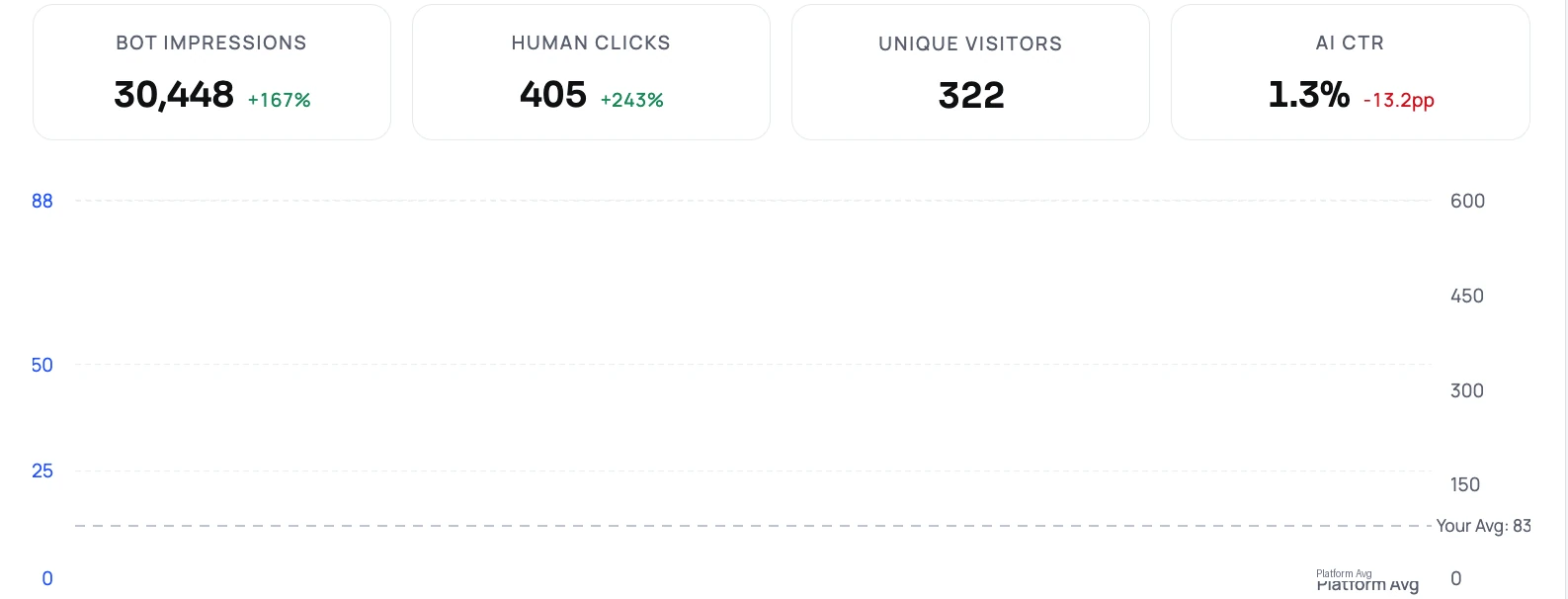
Then compare recorded bot and agent requests, pages/resources delivered and tool questions with success/failure outcomes. AI bot analytics measures the connected traffic that reaches the integration; it cannot report requests stopped upstream without connected edge logs. A delivered response does not prove every fact was used.
Track sampled mentions and citations, landed AI-referral visits, clicks and form attempts alongside confirmed purchases or accepted leads from your analytics/transaction integration. A form attempt is not a conversion receipt, and timing does not deterministically connect a crawl to a sale. Missing referrers and missing instrumentation are coverage gaps, not zero demand.
A controlled rollout beats an all-or-nothing decision
- Define permitted purposes and sensitive paths with security and marketing together.
- Baseline a small set of public catalog/policy pages and record actual request cost.
- Test cache, bounded rate-limit or delivery changes on that same set; preserve a rollback.
- Check response correctness and access, then compare performance and referral outcomes without claiming causality from a simple before/after.
- Use the evidence for prioritized recommendations, content drafts and structured-data fixes ready for your team to review and apply. LightSite maintains its own data layer; source-store changes remain separate approved work.
Start with the free GEO checker to inspect current access, then choose an integration rather than another duplicate checker.
Frequently asked questions
Can I block GPTBot but allow ChatGPT search?
Yes. OpenAI documents GPTBot and OAI-SearchBot as independent controls. Check your firewall as well as robots.txt; an allow rule is not a promise of visibility.
Does a separate AI-serving layer bypass my firewall?
No. A request blocked before it reaches the connected layer cannot be served or measured there. The permitted routes and access policy still apply.
Will blocking AI bots make my store faster?
Only your own request and origin measurements can establish the effect. Blocking low-cost cached traffic may help little; identify expensive paths and compare a controlled rollout.
Can LightSite measure purchases from agents?
It can record connected requests, tool outcomes and tracked actions; confirmed purchases require a successful transaction event. A click, form attempt or inferred checkout action is not a receipt.